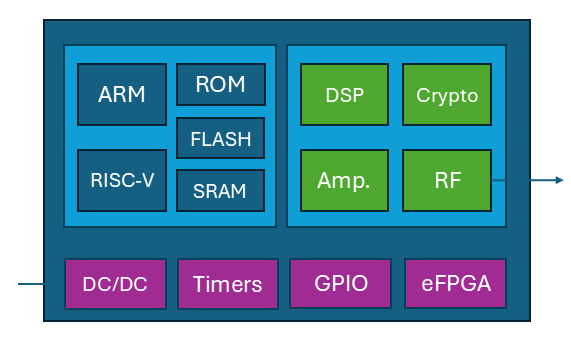
A typical SoC can integrate:
- Arm Cortex-M, Cortex-A or Cortex-R processor IP
- Custom hardware accelerators
- SRAM and memory controllers
- DDR interfaces
- DMA controllers and system interconnects
- SPI, I²C, UART, USB and Ethernet interfaces
- Security engines and secure-boot functions
- Power and clock management
- Analog and mixed-signal interfaces
- Hardware debugging and test circuitry
Unlike a standard microcontroller or application processor, a custom SoC can be optimized for specific workloads, interfaces, power budgets and production requirements.
For example, an industrial equipment manufacturer may develop a custom Arm Cortex-M-based SoC combining real-time control, sensor interfaces, motor-control logic and dedicated signal-processing hardware.
Arm Cortex-M vs. Cortex-A vs. Cortex-R
Selecting the appropriate processor architecture is one of the most important decisions in custom SoC development.
| Arm Processor Family |
Main Characteristics |
Typical Applications |
| Cortex-M |
Low power, compact footprint, embedded control |
IoT, industrial controllers, sensors, medical devices |
| Cortex-A |
High-performance application processing, rich operating systems |
Edge AI, networking, multimedia, embedded Linux |
| Cortex-R |
Deterministic real-time processing |
Automotive, storage controllers, safety-critical systems |
Cortex-M-Based SoCs
These are commonly considered for embedded products requiring low power consumption, fast response and relatively modest processing requirements.
A custom Cortex-M SoC can combine a processor with specialized interfaces, accelerators and integrated control functions.
Cortex-A-Based SoCs
Cortex-A processors target more demanding applications requiring higher processing performance, advanced memory management and operating systems such as Linux.
Typical projects include industrial computing, edge AI, multimedia and communications systems.
Cortex-R-Based SoCs
Cortex-R processors are optimized for real-time applications where predictable response and system reliability are important.
They are relevant to automotive control, storage systems and selected safety-related applications.
The final processor selection should consider software compatibility, available IP, real-time performance, security, power consumption and licensing requirements.
Applications for Custom Arm-Based SoCs
| Application |
Potential SoC Functions |
| Industrial automation |
Cortex-M, real-time control, industrial communication |
| Robotics |
Processor integration, sensor processing, motor-control acceleration |
| Edge AI |
Cortex-A, dedicated NPU, memory subsystem |
| Medical devices |
Low-power processing, sensor interfaces, security |
| Automotive electronics |
Real-time control, diagnostics, safety-related functions |
| IoT devices |
Cortex-M, wireless connectivity, power management |
| Smart cameras |
Image processing, memory control, video acceleration |
| Networking equipment |
Packet processing, Ethernet, security acceleration |
| Consumer electronics |
Application processing, multimedia and connectivity |
A custom Arm-based SoC can integrate functionality previously implemented using several standard chips or an FPGA combined with a processor.
This approach may reduce system complexity and recurring hardware cost while improving performance and power efficiency.
However, the benefits must justify the non-recurring engineering investment and semiconductor manufacturing expenses.
FIND EXPERIENCED ARM SOC DESIGN COMPANIES – GET 3 QUOTES
Typical Arm-Based SoC Architecture
A custom Arm-based SoC generally combines processor IP, memories, interconnects, hardware accelerators and peripheral interfaces.
Arm CPU Core → System Interconnect → Memory, Accelerators and Peripheral Interfaces
Additional subsystems typically include:
- Boot ROM and startup control
- Interrupt controllers
- Clock generation and reset
- Power management
- Security and cryptographic acceleration
- Debug and trace
- Design-for-test circuitry
A major engineering challenge is integrating licensed processor IP with customer-specific RTL while achieving the required performance, power and area targets.
The design team must verify the complete system, including processor operation, memory access, bus transactions, clock-domain crossings, security and peripheral functionality.
Typical Custom SoC Technical Specifications
The following table illustrates a hypothetical industrial Arm Cortex-M-based SoC project.
| Parameter |
Example Design Target |
| Processor architecture |
Arm Cortex-M |
| CPU frequency |
200 MHz |
| Semiconductor technology |
65nm CMOS |
| On-chip SRAM |
1 MB |
| Boot memory |
ROM or supported embedded NVM |
| Custom accelerators |
DSP or application-specific processing |
| Interfaces |
SPI, I²C, UART, CAN |
| Security |
Secure boot, cryptographic engine |
| Power management |
Clock gating, low-power modes |
| Operating temperature |
−40°C to +125°C |
| Package |
QFN or BGA |
| Production volume |
200,000 units/year |
These are illustrative project requirements, not the specifications of an existing Arm processor or commercial SoC. Feasibility depends on the selected processor, foundry process, IP availability and implementation.
For Cortex-A designs, additional requirements may include external DDR memory, high-speed interfaces, cache coherency, operating-system support and advanced power-management features.
Choosing the Right Semiconductor Technology Node
Arm-based SoCs can be implemented across many semiconductor technology nodes.
Selecting a smaller node can improve digital integration density and enable higher performance, but it may increase design and manufacturing costs.
| Technology Node |
Potential SoC Applications |
| 180nm / 130nm |
Selected embedded controllers and mixed-signal SoCs |
| 90nm / 65nm |
Industrial control, embedded processing, mixed-signal SoCs |
| 55nm / 40nm |
Low-power processing, IoT and integrated controllers |
| 28nm |
Higher-performance embedded SoCs, networking and accelerators |
| 22nm FD-SOI |
Low-power and mixed-signal processing applications |
| 16nm / 12nm |
More complex digital SoCs and processing systems |
| 7nm and below |
High-performance computing and advanced accelerators |
Not every Arm processor or IP subsystem is available or commercially supported in every process node.
The selected foundry must provide suitable standard-cell libraries, SRAM compilers, I/O libraries and other required physical IP.
Design partners should verify processor implementation requirements, process compatibility, timing targets and IP licensing before committing to a technology.
How Much Does Custom Arm-Based SoC Design Cost?
Custom SoC development requires non-recurring engineering (NRE) investment covering architecture, RTL development, IP integration, verification, physical design and silicon validation.
The total cost depends on the processor architecture, complexity, semiconductor node, reuse of existing IP, verification requirements and manufacturing scope.
Illustrative SoC Development Budgets
| Project Scope |
Indicative Engineering Budget |
| Architecture and feasibility study |
$50,000–$150,000 |
| Relatively simple Cortex-M-based SoC |
$500,000–$2 million |
| More complex mixed-signal or multicore SoC |
$2 million–$5 million |
| Advanced Cortex-A SoC with accelerators |
$5 million–$10 million+ |
These are broad planning scenarios, not independently verified industry-average prices or binding supplier quotations. The engineering budget may exclude Arm licensing, third-party IP, EDA tools, mask sets, fabrication, packaging, production test and qualification.
Arm IP Licensing Costs
Arm processor IP generally requires appropriate commercial licensing rights.
Arm offers several licensing programs, including Flexible Access and Total Access.
Under the currently advertised Flexible Access Standard Tier, annual membership is $85,000, while eligible early-stage startups may qualify for zero-cost access. Depending on the program and IP, additional licensing payments and royalties may apply when the chip is manufactured and shipped.
The actual licensing structure depends on the selected IP, agreement and commercial arrangements.
A design partner may assist with licensing discussions, but customers should confirm who holds the necessary design and manufacturing rights.
Source: Arm Flexible Access.
Prototype Manufacturing Costs
Multiproject Wafer (MPW) programs can reduce the initial cost of fabricating prototype silicon.
For example, the published EUROPRACTICE 2026 schedule includes:
| Process |
Published Standard Prototype Price |
| TSMC 65nm mini@sic |
€4,491 minimum for 1 mm² |
| UMC 65nm MPW |
€43,750 per 4 × 4 mm block |
| TSMC 28nm mini@sic |
€10,609 minimum for 1 mm² |
These prices represent particular fabrication services under published conditions, not full SoC development costs. Larger designs incur additional charges, and the listed MPW service may not support every IP or design option required by a commercial SoC.
Source: EUROPRACTICE 2026 Schedule and Prices.
REQUEST A CUSTOM ARM SOC DESIGN COST ESTIMATE
Custom Arm SoC Development Schedule
A relatively straightforward Arm-based SoC may require approximately 12–24 months from specification to production readiness.
More complex Cortex-A, multicore or advanced-node programs can require considerably longer.
| Development Phase |
Indicative Timeline |
| Requirements and architecture |
Months 1–3 |
| Processor and IP selection |
Months 2–4 |
| RTL design and IP integration |
Months 4–9 |
| Functional verification |
Months 5–12 |
| Physical design and signoff |
Months 10–15 |
| Tapeout and semiconductor fabrication |
Months 15–19 |
| Silicon validation and software bring-up |
Months 19–22 |
| Production qualification and ramp-up |
Months 22–24+ |
Phases overlap, and actual schedules depend on scope, technology, foundry availability and silicon revisions.
A typical design program includes architecture modeling, RTL development, simulation, verification, synthesis, static timing analysis, placement and routing, power analysis and physical signoff.
Software development should begin early, preferably using virtual platforms, FPGA prototypes or other suitable development environments.
Standard Processor vs. Custom Arm-Based SoC: Cost Comparison
A custom SoC usually requires significantly greater upfront investment than purchasing a standard processor.
However, at sufficient production volume, integration and recurring cost savings may justify development.
Consider the following hypothetical project:
| Parameter |
Example |
| Custom SoC development and licensing investment |
$2 million |
| Annual production volume |
200,000 units |
| Product lifetime |
5 years |
| Total production volume |
1 million units |
| Existing processor-based system cost |
$12/unit |
| Custom SoC-based system cost |
$8/unit |
| Recurring system saving |
$4/unit |
| Total savings before initial investment |
$4 million |
| Net savings after initial investment |
$2 million |
Under these assumptions, the break-even point is 500,000 units, equivalent to approximately 2.5 years at the stated annual volume.
The example assumes that the $2 million upfront investment covers all relevant development and licensing costs, and that the $8 recurring cost captures fabrication, package, test and other required system costs.
Real projects must account for yield, inventory, financing, royalties, redesigns, qualification and changes in production volume.
How to Select an Arm SoC Design Partner
An experienced SoC design company can reduce technical risk and support the development process from architecture to manufacturing.
Important selection criteria include:
- Processor integration experience: Previous silicon-proven Cortex-M, Cortex-A or Cortex-R projects.
- IP integration capabilities: Experience with Arm AMBA interconnects, memory subsystems, peripherals and third-party IP.
- RTL and verification expertise: SystemVerilog, UVM, formal verification and system-level validation.
- Physical design capabilities: Foundry PDK experience, synthesis, place and route, timing closure and signoff.
- Software support: Boot firmware, board support packages, drivers and operating-system integration.
- Manufacturing relationships: Foundry, packaging, test and production support.
- Commercial arrangements: Clear deliverables, IP licensing responsibilities, ownership and NRE milestones.
Customers should also verify whether a prospective design company is an Arm Approved Design Partner when that qualification is important to the project.
AnySilicon helps companies identify relevant ASIC and SoC design partners for their technical and commercial requirements.
Frequently Asked Questions
Can a custom Arm-based SoC include AI accelerators?
Yes. A custom SoC can combine Arm processor IP with dedicated AI or DSP accelerators, subject to system performance, memory architecture, semiconductor process and licensing requirements.
Can an FPGA design be converted into an Arm-based ASIC?
Potentially. Existing FPGA logic can sometimes be adapted for ASIC implementation and integrated alongside Arm processor IP. The design will require technology mapping, verification, physical implementation and silicon validation.
What is the difference between Arm and RISC-V SoC design?
Arm-based SoCs generally use licensed Arm processor technology, while RISC-V is an open instruction set architecture with multiple processor implementations and licensing models.
Both approaches can support custom SoC development. Processor ecosystem, software compatibility, technical requirements and total project cost determine suitability.
Is a custom Arm SoC suitable for low-volume products?
It can be technically feasible, but the NRE and IP licensing costs may make a standard processor or FPGA-based solution more economical at lower volumes.
Can AnySilicon help with turnkey SoC development?
AnySilicon connects customers with semiconductor design partners offering architecture, RTL design, verification, physical implementation, tapeout, packaging, testing and manufacturing support.
Find the Right Custom Arm-Based SoC Design Partner
Whether you are developing an industrial controller, medical device, automotive electronics platform, AI accelerator or specialized embedded processor, selecting the right SoC design partner is essential.
AnySilicon helps companies find experienced ASIC and SoC design partners capable of supporting Arm processor integration, custom RTL development, physical implementation and turnkey chip development.
Submit your technical requirements and let AnySilicon help identify up to three relevant design partners for your project.
GET 3 ARM-BASED SOC DESIGN QUOTES
Start your custom Arm-based SoC development project with AnySilicon.
Arm and Cortex are trademarks or registered trademarks of Arm Limited or its subsidiaries. References to Arm technology do not imply that AnySilicon is affiliated with or endorsed by Arm.