Deciding whether to build an ASIC is rarely a clear yes or no. Most teams arrive at the question gradually. FPGA costs rise. Power budgets tighten. Schedules slip. Supply risks appear. At some point, staying on the current platform feels increasingly uncomfortable — but committing to custom silicon feels risky.
That tension is normal.
The goal of this page is not to convince you to build an ASIC. It is to help you decide whether ASIC makes sense for your product now, later, or not at all, using the same reasoning experienced teams apply in practice.
ASIC decisions fail most often because they are framed too narrowly.
Some teams focus only on unit cost. Others fixate on NRE. Some assume ASIC is only for large companies. Others jump too early because competitors are doing it.
In reality, ASIC decisions sit at the intersection of:
Getting the timing wrong can be just as expensive as choosing the wrong technology.
Experienced teams do not start with nodes or vendors. They start with constraints.
Below are the most common drivers that push teams toward (or away from) ASIC. You do not need all of them — but you usually need at least one to be unavoidable.
When power, thermals, or battery life limit features or form factor, FPGA optimization eventually stops scaling.
Read more: Power Is Killing Your Product: When ASIC Beats FPGA on Efficiency
If margins compress as volume grows and BOM cost cannot be reduced structurally, platform choice becomes a business issue, not an engineering one.
Read more: Your BOM Is Too High: 6 Ways ASIC Integration Cuts Cost
ASIC economics depend on amortization across time and volume, not on a single shipment forecast.
Read more: ASIC vs FPGA Break-Even: When the Economics Flip
ASIC timelines are often underestimated, especially around verification, IP integration, and signoff.
Read more: Why Your ASIC Schedule Is Wrong: Realistic Tapeout Timelines
Choosing a node too early — or too aggressively — is one of the fastest ways to add cost and risk without benefit.
Read more: 65nm vs 40nm vs 28nm: How Teams Choose a Node in Practice
Long-lifecycle products face risks that off-the-shelf silicon is not designed to handle.
Read more: 10-Year Product Lifetimes: Why Off-the-Shelf Silicon Breaks Down
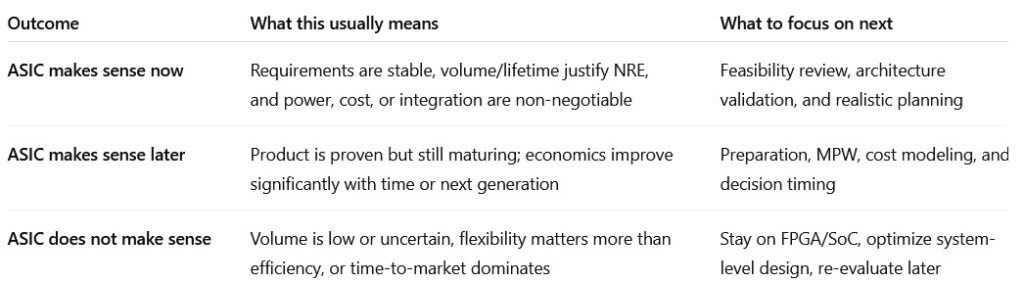
A good ASIC decision does not force a single answer. In practice, there are three correct outcomes.
This is usually the case when:
In this case, the next step is structured feasibility, not optimism.
Many successful products fall into this category.
Signals include:
Here, the goal is preparation, not commitment.
ASIC is the wrong move when:
Avoiding ASIC at this stage is often the correct strategic choice.
Read more: When You Should NOT Build an ASIC (And What to Do Instead)
Teams that succeed with ASIC do not guess.
They:
This avoids emotional or politically driven decisions.
If you want a neutral, structured way to assess your situation, we built a simple tool to help.
The ASIC or Not? Decision Wizard takes about two minutes and gives a directional answer based on your product’s constraints, maturity, and goals.
No specs required. No sales pitch.
Run the ASIC or Not? Decision Wizard to see whether ASIC makes sense for your product now, later, or not at all — and what to focus on next.
👉 /asic-or-not