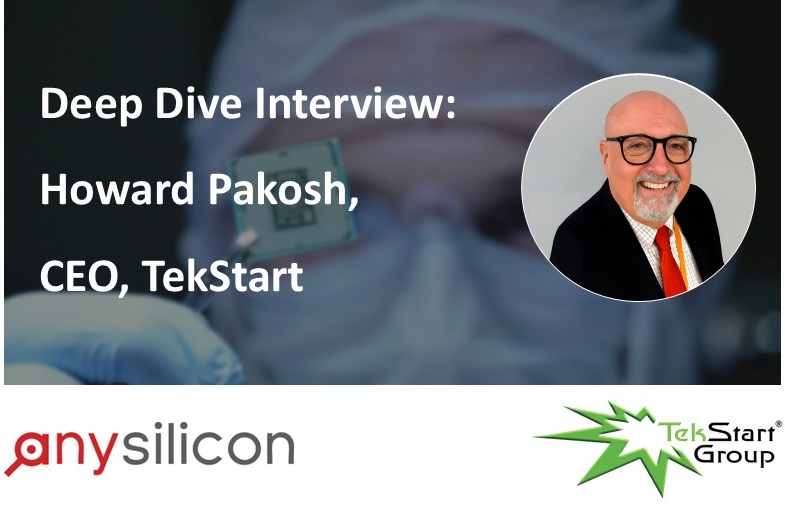
This interview features Howard Pakosh, CEO & Founder at The TekStart Group.
Can you describe your company’s founding vision and how it has evolved to address the changing landscape of the semiconductor industry?
When I founded TekStart® back in 1998, the idea was simple but ambitious. Take breakthrough ideas that might otherwise never see daylight. Then, provide capital, expertise, and leadership to become a real business. The semiconductor industry has always been unforgiving. You need both innovation and execution. Over the years, TekStart has evolved from being primarily a commercialization partner to becoming an end-to-end builder of technology ventures, with a heavy emphasis today on semiconductors and AI. Our vision has stayed the same. How can we help innovators succeed? But the way we do it has broadened. As the industry has grown more global, more competitive, and frankly, more complex.
What core technological capabilities and innovations differentiate your company and position you for future success in the semiconductor market?
I think our edge lies in combining capital with capability. Through our ChipStart® business unit, we’ve developed deep expertise in custom ASIC design and outsourced operations. That means we can take a company from idea to silicon much faster than they could alone. Our current focus is on a new Edge AI chip, Cognitum, being developed by our ChipStart business unit. Through this process, we’ve demonstrated that we’re not just enabling others – we’re innovating ourselves. Getting up to 65 TOPS of performance while consuming less than 2 watts is a breakthrough. That kind of performance-per-watt balance creates opportunities that didn’t exist before.
Beyond your current product portfolio, what emerging technologies are you exploring, and what opportunities do you see?
AI at the edge is front and center for us. Cloud AI gets a lot of attention, but the future is intelligence where the data is generated. On a camera, a sensor, or a wearable. We’re also paying close attention to advanced packaging. Moore’s Law scaling is slowing. The ability to integrate heterogeneous compute elements such as CPU, GPU, and AI accelerators into a tightly coupled package will be key. The opportunities range from security and surveillance to agriculture, where low-power AI-powered processes can autonomously operate with greater efficiency and collaboration.
What hurdles did you overcome in bringing Cognitum to market?
The biggest challenge was reconciling performance with power efficiency. Historically, you had to pick one. With Cognitum, we had to rethink architecture from the ground up. It wasn’t about one big breakthrough but dozens of design decisions that, collectively, gave us an inference engine that is both powerful and efficient. That’s what makes Cognitum viable in edge environments where both battery and thermal budgets are tight.
What are the most pressing challenges the semiconductor industry faces today?
Three come to mind: supply chain fragility, energy efficiency, and time-to-market. We can’t control global supply chains, but we can design chips that aren’t dependent on exotic nodes. We can’t single-handedly fix the industry’s carbon footprint, but we can deliver higher performance per watt. And while we can’t accelerate fab construction timelines, we can help our partners move faster from concept to production silicon. That’s where we focus.
Looking ahead, which markets have the most growth over the next 5-10 years?
Edge AI is going to be enormous. Think industrial automation, smart agriculture, AR/VR, surveillance – these all need AI inference on the edge, with ultra-low power and minimal latency. Cognitum is designed for exactly that, but our broader strategy is to build ecosystems in those verticals that support device-to-device processing as a distributed intelligence model. That means working with OEMs, system integrators, and application developers, not just handing over chips.
What emerging technologies will have the most significant impact on the semiconductor industry in the coming years?
AI is the obvious one, but I’d put advanced packaging and chiplet architectures right alongside it. The monolithic chip era is ending. The future is modular. Being able to stitch together specialized compute elements in ways that maximize performance and efficiency. That’s where the industry is headed, and we’re already building partnerships to prepare for it.
How do you see semiconductor architectures evolving over the next decade?
We’ll still see node shrinkage, but the real story will be in specialization and integration. General-purpose compute is giving way to domain-specific accelerators. As AI becomes more agentic and is pushed out to the edge, future semiconductor architectures will need to be designed for autonomous decision-making under tight power, latency, and thermal constraints in edge devices. Architectures will fragment, but those that can integrate heterogeneous components into cohesive systems will win.
What role will TekStart play in shaping the future?
Our role is to be both a catalyst and a bridge. We don’t just fund companies. We operationalize them to help them scale and go to market. Cognitum is a perfect example of spotting a gap, investing in technology, and bringing it forward. Our initiatives will continue to focus on pairing innovation with the resources to commercialize it – not just building chips but building companies that endure.
What strategic partnerships are most critical for success?
No one succeeds in semiconductors alone. We work with design houses, IP providers, foundries, and end customers across North America and Europe. What really matters is trust. After decades in this business, we’ve built a reputation for showing up, protecting IP, and delivering on commitments. That kind of trust isn’t just nice to have. It’s what makes innovation possible at the pace the market demands.