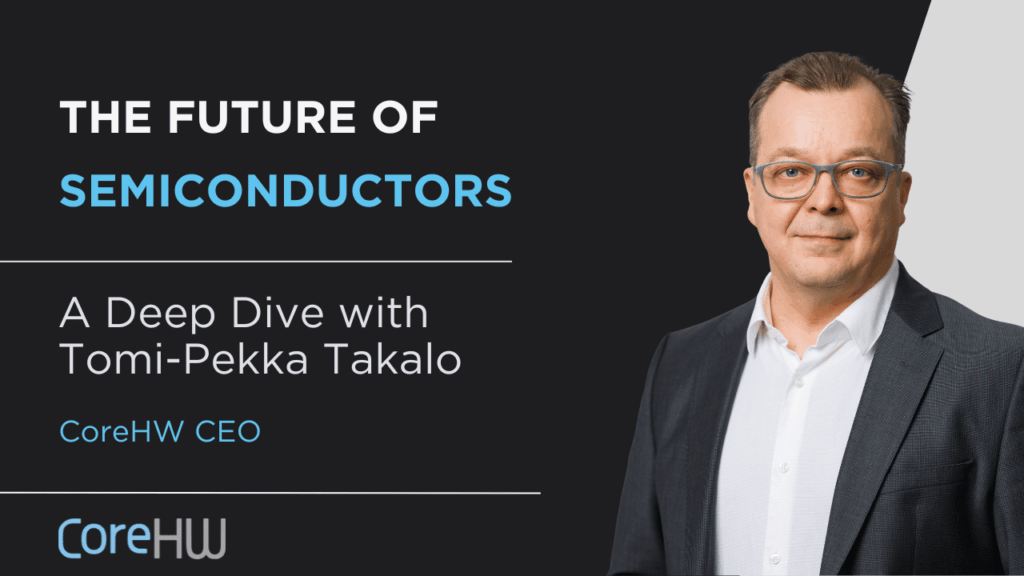
This interview features: Tomi-Pekka Takalo, CEO and co-founder at CoreHW.
Can you describe your company’s founding vision and how it has evolved to address the changing landscape of the semiconductor industry?
CoreHW was founded in 2013 by RF engineers with a vision to deliver high-quality custom radio-frequency ICs. We initially focused on RF/analog design services. As the industry shifted with the rise of IoT (billions of connected devices) and new wireless needs, we expanded our scope.
Today, we not only offer IC design expertise but also our own products – for example, centimeter-accurate indoor positioning solutions – leveraging our strengths in RF, mmWave, and power-efficient IC design. In essence, our original mission of enabling cutting-edge wireless technology remains, but we have evolved to meet modern market demands.
What core technological capabilities and innovations differentiate your company and position you for future success in the semiconductor market?
High-Performance RF for Next-Generation Applications: Our company specializes in advanced RF and mmWave technologies that set us apart in the semiconductor market. This includes high-performance RF transceivers for automotive radar and communication, cutting-edge wireless systems for 5G/6G networks, and even RF control electronics for quantum computing. These capabilities position us to power future needs such as autonomous vehicle sensors, ultra-fast 6G connectivity, and quantum computer control systems, giving us a competitive edge in emerging high-growth markets
Ultra-Low-Power IoT Connectivity: We also excel at minimizing power consumption in wireless ICs, which is crucial for the Internet of Things. Our expertise in Bluetooth and other IoT radio technologies enables battery-friendly, multi-year operations for sensors and devices. By pushing towards the lowest possible power budgets without sacrificing performance, we make scalable IoT deployments feasible – a key differentiator as IoT networks continue to expand. This focus on energy-efficient design not only supports current wireless standards but also lays the groundwork for sustainable “green” electronics in future networks.
Beyond your current product portfolio, what emerging technologies are you actively researching or developing, and what are the potential applications and market opportunities?
Beyond our current product portfolio, we are actively researching and developing advanced RF solutions for the aerospace and defense sector. We are innovating high data-rate datalinks and next-generation radar systems to meet growing demands in this field. These innovations will enable new applications such as secure high-speed communication between aircraft and satellites, advanced radar imaging for defense, and robust connectivity in space. The aerospace/defense market is expanding, and our work on specialized RFICs (e.g. ruggedized transceivers, beamforming radar chips) positions us to capitalize on opportunities in avionics, space communications, and military systems.
Additionally, our ongoing R&D efforts in core areas like 6G wireless and quantum computing continue to grow and build new IPs and applications.
How does your company’s culture and organizational structure support innovation and adaptation to rapid technological advancements?
Our organization is built around innovation. We move rapidly from concept to prototype and beyond, advancing designs into validated, production-ready solutions. Many of us are industry experienced engineers mentoring younger designers, and we encourage open dialogue – everyone’s input is valued. We also foster a culture of curiosity and excellence: we are “fearless in taking on new challenges” and never settle for the minimum. This mindset, combined with continuous learning and collaboration (including partnerships with academia), ensures we can rapidly adapt to new technological advancements
What were the most significant technological hurdles your company overcame in the past year, and what innovative solutions did you employ? (Focus on the how)
One of the most significant technological hurdles we tackled in the past year was the rapid development of a massive multi-channel radar transceiver IC. The challenge was to design a complex, high-performance radar chip under a very tight timeline – and get it right on the first attempt. We achieved first-silicon success (i.e., “first-time-right” functionality) with excellent performance.
This was accomplished by embracing an advanced modeling and verification workflow on top of the usual IC design flow. We extensively used MATLAB/Simulink for system-level modeling of the radar signals and algorithms, and integrated SystemVerilog-based testbenches for verification throughout design iterations.
By co-simulating the system’s behavior with the circuit design, our engineers could iron out potential issues early and optimize the architecture before tape-out. This model-based, top-down design approach drastically reduced the need for multiple prototyping spins – effectively allowing us to go from initial design to a working silicon prototype in one go.
What are the most pressing challenges currently facing the semiconductor industry, and how is your company uniquely positioned to address them?
The semiconductor industry is facing several broad challenges, and our company has positioned itself to address them in distinctive ways:
Geopolitical Uncertainty in the Supply Chain: Global tensions and export controls have introduced uncertainty, causing investment to slow in some sectors and accelerate in others. Our strategy here is agility – we maintain a diverse customer base across commercial, aerospace and security sectors so that we can pivot resources toward high-growth areas when needed. By having technology applicable to multiple sectors, we mitigate risk and continue innovating despite geopolitical headwinds.
Regional Gaps – Europe’s Semiconductor Landscape: Europe has long held a strong position in RF and telecommunications, with global leaders such as Nokia and Ericsson driving global telecom networks. This foundation remains a key strength, even as Europe works to close the gap in areas like cutting-edge semiconductor manufacturing and AI-centric chip design compared to the US and Asia. At CoreHW, we leverage this RF leadership while firmly positioning ourselves in a global ecosystem. Our collaborations extend beyond local networks, engaging international partners, customers, and research initiatives.
Automotive Industry Disruption: The automotive sector is transforming with the rise of electric vehicles and new entrants. At the same time, established Tier-1 suppliers continue to play a central role in defining semiconductor requirements. We address this landscape by aligning our solutions with both emerging EV needs and existing automotive supply chains. For example, we design automotive-grade chips for radar, battery management, and connectivity that meet the stringent reliability standards of Tier-1s, while also innovating EV-specific demands. This dual focus ensures our technology will be integral to the next generation of vehicles, whether coming from established automakers or disruptive newcomers.
Exploding Data & Energy Efficiency Imperative: As device counts and data traffic explode, a major industry-wide challenge is improving energy efficiency – future networks must deliver far more data per Joule of energy to be sustainable. We address this by engineering ultra-low-power circuits and power-efficient architecture in our products. For instance, RF transceivers aim to maximize bits-per-Joule delivered without sacrificing performance, an approach aligned with 6G research priorities on energy efficiency. By innovating in power-efficient design, we help tackle the energy footprint problem that is critical for network operators and the environment.
Demand for Precise Indoor Positioning: Another emerging need is enabling precise indoor positioning, which legacy wireless technologies have struggled with. Here, we are uniquely positioned to deliver a solution. Our advanced Bluetooth Angle-of-Arrival (AoA) technology provides centimeter-level positioning accuracy for indoor environments, a leap ahead of older Bluetooth beacon, UWB, and Wi-Fi methods. This breakthrough addresses a key problem for industries from smart factories (tracking assets and robots with high precision) to healthcare (locating equipment or patients in a hospital). By leveraging our specialized RF and custom IC design know-how, we have created RTLS solutions that achieve ultra-accuracy and low power consumption simultaneously. This is a capability many generic RTLS providers cannot easily match, underscoring how our deep RF expertise translates into new value-added services.
CoreHW has one of the strongest RF and analog IC design teams in Europe, supported by a robust over 300 IP portfolio. This expertise enables us to deliver tailored, high-performance semiconductor solutions.
What were the key learnings from your most significant project or initiative in the past year, and how will these shape your future strategies?
Our complete RTLS rollout taught us an important lesson: to create real impact; it is not enough to deliver high-performance chips alone—we need to provide complete solutions. By integrating our CoreHW hardware (tags and locators) with a software platform, we achieved a secure, cm-accurate indoor positioning system.
This underscored the value of tight hardware-software integration, where aligning architectures at system level not only maximizes performance but also ensures seamless deployment and higher end users’ satisfaction.
Which market segments or applications do you see as having the greatest potential for growth in the next 5-10 years, and what is your company’s strategy to capitalize on these opportunities?
In the next 5–10 years, we see significant growth in a few areas:
RTLS: In industrial and logistics environments such as smart factories and warehouses, centimeter-level indoor positioning combined with IoT sensors provides real-time visibility of assets, improving both safety and operational efficiency. In healthcare, hospitals are deploying wearable tags and precise indoor tracking to enable patient monitoring, optimize asset utilization, and reduce response times. By integrating low-power RF, advanced antenna arrays, and localization algorithms, RTLS solutions deliver robust accuracy and scalability that traditional wireless systems could not achieve.
In Automotive, vehicles increasingly rely on semiconductors for ADAS, radar, electrification, and V2X (vehicle-to-everything) communication.
In Radar, multi-channel mmWave radar enables industrial automation through precise motion sensing, supports non-contact healthcare monitoring, and strengthens security with drone detection and perimeter surveillance.
AI is already reshaping our industry – we see growing demand for different types of AI chips. We are preparing by using machine learning in our design workflow and ensuring our RF/analog IP meets the high-speed connectivity and sensing needs of AI-driven devices.
Advanced packaging is another key trend. Monolithic chips are giving way to chiplet-based and 3D-integrated designs to boost performance and reduce costs as Moore’s Law slows. We are engaged in several projects applying chiplet-ready architecture and co-developing products with heterogeneous integration in mind.
Quantum computing is an emerging domain we actively track, driven by the central role of RF and timing infrastructure in scaling real systems. High-fidelity qubit control and readout depend directly on ultra-low phase noise clocking, deterministic timing, and tightly integrated microwave signal chains. These requirements align closely with our core expertise. Our work applies across quantum communication, sensing, and computing, where room-temperature RFICs for control and measurement, robust cryogenic RF front-ends, and carefully engineered circuit architectures are critical to preserving signal integrity and minimizing noise, drift, and crosstalk. By leveraging deep experience in RF design, PLLs, and analog front-end integration, we focus on turning complex, rack-scale control systems into highly integrated and scalable hardware platforms.
We must remain at the leading edge of technology every day to play an active role in shaping the future of the semiconductor industry.
What are the key ethical considerations and societal implications of advancements in semiconductor technology, and how is your company addressing these concerns?
Advancements in semiconductors bring important ethical and societal questions. One is privacy: technologies like precise indoor positioning must be used responsibly. We embed strong security and privacy features into our solutions – for example, our RTLS platform uses encryption and access controls to protect location data, and we guide customers on positive use cases such as safety and efficiency.
Another key consideration is sustainability. Our mission emphasizes building a “greener world,” which we address through energy-efficient, ultra-low-power IC design and advanced power management architectures. By leveraging custom ASICs instead of general-purpose ICs, we optimize every transistor and circuit for the application, minimizing wasted energy, reducing heat, and lowering the overall carbon footprint. This specialization also extends product lifetimes, reduces e-waste, and enables smaller, lighter systems with fewer components.
What are your strategies for attracting and retaining top talent to support your long-term technological vision?
We attract top talent by offering the chance to work on cutting-edge projects. At CoreHW, engineers get to “create components of the future” and tackle challenges no one has solved before – a compelling draw for ambitious people.
To retain talent, we have built a culture that values innovation and supports work-life balance. Senior experts mentor newer engineers, and we encourage continuous learning. We offer flexible hours, hybrid work options, and a supportive environment, so employees feel valued both professionally and personally. This combination of exciting technical work and a positive, growth-oriented culture helps us attract and keep the best engineers in the long run.
What strategic partnerships or collaborations are crucial to your company’s success in navigating the future of the semiconductor industry?
We collaborate across academia, foundries, EDA providers, and development partners, while working with leading global corporations to solve real-world challenges. At the same time, we continue building our RTLS ecosystem to deliver scalable, end-to-end solutions.
About CoreHW
CoreHW is a Finnish fabless semiconductor company specializing in advanced RF, analog, and mixed-signal IC design, custom ASIC development, and real-time location systems (RTLS). With deep expertise in mmWave, antenna design, and ultra-low-power wireless technologies, CoreHW delivers semiconductor solutions for automotive, IoT, healthcare, aerospace, and telecommunications industries worldwide.
For media inquiries:
Email: sales@corehw.com
Website: https://www.corehw.com/
LinkedIn: https://www.linkedin.com/company/corehw/