
87 Views

ElectraIC Avionics IP Cores for FPGA: MIL-STD-1553B, ARINC 429 and ARINC 664

AnySilicon IP Vendor Spotlight: Avionics communication interfaces demand precise timing, dependable data handling and extensive verification. For FPGA design teams, developing these protocol functions from scratch can add significant integration and validation effort.


In this spotlight, Ates Berna, General Manager and Managing Partner of ElectraIC, introduces the company’s avionics IP core family covering MIL-STD-1553B, ARINC 429 and ARINC 664 Part 7. We examine the design problems these cores address, their technical features, and the licensing and verification material available to customers.


About ElectraIC

ElectraIC is an electronic design and verification company founded in 2014, with offices in Türkiye, Belgium and the Netherlands. The company provides digital IC design, embedded software, electronic board and equipment design, advanced verification and functional-safety engineering. ElectraIC also develops high-reliability IP cores and embedded-system products for defense, aerospace and other safety-critical applications. Its portfolio includes communication, interface, cryptographic and processing IP for ASIC and FPGA platforms, supported by customization, integration and verification expertise.


What makes avionics communication IP challenging to integrate?

Each protocol brings a different engineering challenge. A MIL-STD-1553B implementation must coordinate bus control, terminal operation, monitoring, host communication and error handling. ARINC 429 designs need scalable receive/transmit channels with filtering and buffering. ARINC 664 Part 7 adds deterministic Ethernet communication, Virtual Link scheduling and redundant network paths.


ElectraIC’s approach is to provide configurable FPGA IP cores with defined host interfaces and supporting engineering documentation, reducing the amount of protocol-specific functionality a customer needs to develop internally.


MIL-STD-1553B IP Core: Multiple bus functions in one FPGA implementation

ElectraIC’s MIL-STD-1553 IP Core implements communication between a host processor and an external MIL-STD-1553 transceiver. A key feature is its ability to operate as a Bus Controller, two independent Remote Terminals and a Bus Monitor simultaneously.


The core supports AXI4-Lite or an asynchronous host interface and is offered as synthesizable VHDL RTL or as a targeted FPGA netlist. It is also available through the AMD Vivado IP Catalog. Customers can select narrower licensing configurations such as a single Remote Terminal, Bus Controller or Bus Monitor, depending on system requirements.
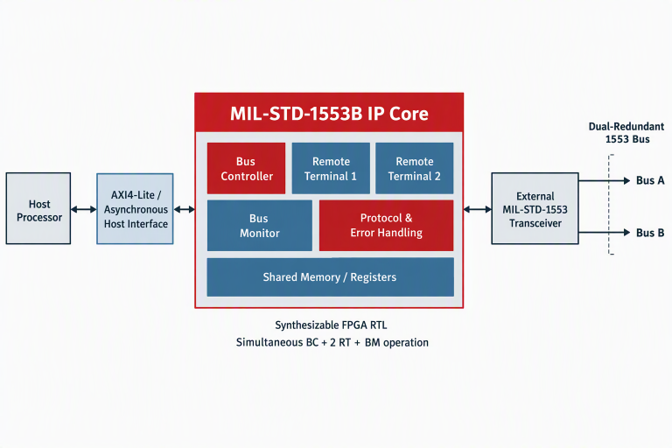

Figure 1. MIL-STD-1553B IP Core architecture: simultaneous Bus Controller, two Remote Terminals and Bus Monitor functions.

For integration, ElectraIC supplies documentation, synthesis scripts, a testbench and reference designs for Xilinx devices. Optional packages include a SystemVerilog/UVM verification environment and DO-254 certification data, subject to the applicable licensing terms.


ARINC 429 IP Core: Scalable multichannel receive and transmit processing

The ARINC429 IP Core combines receiver and transmitter processing, controller logic, internal memory, filtering, buffering and external-memory access.


Its configurable architecture supports up to 32 receive channels and 16 transmit channels, operating at the two standard ARINC 429 rates of 12.5 kbit/s and 100 kbit/s. It also provides 1,024-word individual and circular buffers per channel, SDI/ESSM/Label filtering implemented in the FPGA, and a 32-bit AXI interface for host and memory communication.
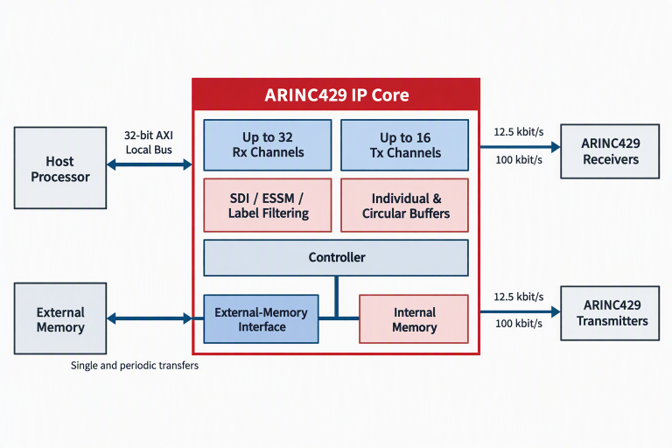
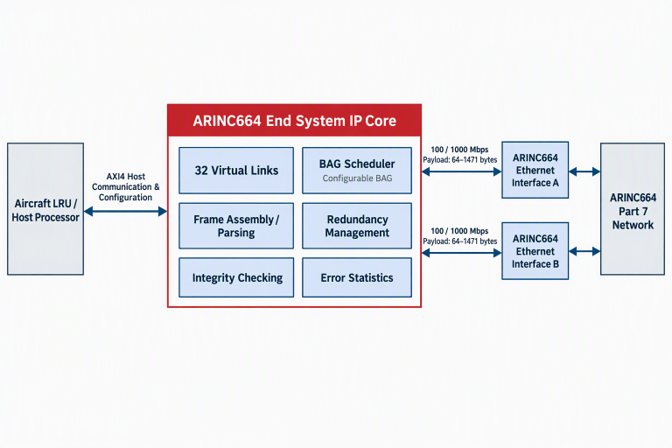
 

Figure 2. ARINC 429 IP Core architecture with scalable receive/transmit channels, filtering, buffering and AXI host access.

According to ElectraIC, the core is field approved and designed for DO-254 compliance. Customers should confirm what evidence and certification support are available for their particular program. An optional DO-254 Certification Data Package is offered.


ARINC 664 Part 7 End System IP Core: Deterministic Virtual Link communication

ElectraIC’s ARINC664 End System IP Core is designed to exchange data between aircraft Line Replaceable Units (LRUs) and an ARINC 664 Part 7 network.


The architecture supports 32 Virtual Links, adjustable Bandwidth Allocation Gap (BAG) values, frame lengths from 64 to 1,471 bytes, and configurable redundancy and integrity checking. It includes two ARINC 664 Ethernet interfaces, AXI4-based host communication and configuration, error statistics, and support for 100 Mbps and 1,000 Mbps operation.

Figure 3. ARINC 664 Part 7 End System architecture for deterministic Virtual Link processing and redundant Ethernet connectivity.

For system designers, the core provides a defined interface between application traffic and scheduled, redundant Ethernet transmission. Licensing and project-specific delivery details are available directly from ElectraIC.


What do customers receive when licensing these IP cores?

Deliverables vary by product and license. For MIL-STD-1553B, options include encrypted RTL, encrypted netlist, or packages combining IP with a verification environment. The standard material includes documentation, synthesis scripts and a bare-metal driver for Xilinx SDK. Training, technical support and updates are also described in ElectraIC’s offering.


For ARINC 429, licensing options include encrypted RTL or netlist, with an optional DO-254 Certification Data Package. ElectraIC also offers first-time-user training and updates. For ARINC 664, customers should request the applicable delivery format, licensing terms and support scope directly from the vendor.


How is the maturity of the IP demonstrated?

ElectraIC reports 893 RTL verification test cases and 844 FPGA verification test cases for its MIL-STD-1553 core. Its materials also describe testing against applicable SAE AS4111, AS4112, AS4113, AS4114 and AS4116 test plans, and state that the IP core and related board received a TRTEST Product Conformity Certificate.


For ARINC 429, ElectraIC cites field approval and availability of a DO-254 certification-data option. The ARINC 664 offering is described through its End System feature set; the interview material does not provide an equivalent third-party conformity result for that core. Prospective licensees should evaluate the verification evidence and certification artifacts needed for their own system.


Learn more about ElectraIC’s avionics IP portfolio

For aerospace and defense teams evaluating FPGA-based avionics communication, ElectraIC’s portfolio offers three distinct protocol implementations with configurable features and integration support.


Explore the ElectraIC Design IP portfolio or contact the company at sales@electraic.com for technical documentation, licensing details and program-specific verification requirements.


Learn more ElectraIC’s IP portfolio on AnySilicon:


Logo Image
Privacy Overview

This website uses cookies so that we can provide you with the best user experience possible. Cookie information is stored in your browser and performs functions such as recognising you when you return to our website and helping our team to understand which sections of the website you find most interesting and useful.