

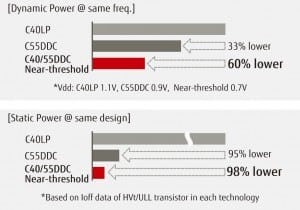
Mie Fujitsu Semiconductor Ltd (MIFS) and CSEM have penned a joint development agreement to cooperate in the development of Deeply Depleted Channel (“DDC”) and near/sub-threshold technologies for the IOT/Wearables market. The agreement encompasses the development of ultra-low voltage, ultra-low power standard cell libraries, power management cells and memories as well
Read More
Firstly let me ask what strikes your mind first when I say performance?
Intel started designing processors with MHz to GHz frequencies (Improving the performance of course, but if we see the advantage there might be some flaws too). Yes serially it was possible to send and receive the data

As the ASIC design is moving towards maskset creation and tapeout, the cost of design changes are increasing exponentially. It’s easier and cheaper to modify the ASIC design and even redo some of the chip architecture early the design stage. However it’s much more difficult and far more expensive after
Read More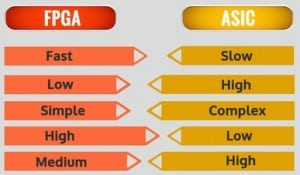
This is a high level article for those who are debating whether to use FPGAs or ASICs and need some technical and commercial insight to help ease the decision process. Both technologies, ASICs and FPGAs are absolutely fantastic and have great benefits but it’s up to you to figure out,
Read More
As technology evolves, more functionality is being added on SOCs. At same time, pressure is building up to reduce operating and standby power. Today the market is focused on reducing power in wide spectrum of SOCs from CPUs, GPUs and Mobile not just IOT/wearable SOCs. Battery powered SOCs require
Read More
Thanks to the $30 million investment made through government funding, the American Defence Advanced Research Projects Agency (DARPA) is set to start a new program that will enable a significant cut down of costs for custom integrated circuits for specific tasks (ASIC).
The revolutionizing program will be called CRAFT