



Aug-27-2026 — The global semiconductor industry is experiencing one of the strongest expansion periods in its history, with artificial intelligence and an extraordinary surge in memory demand pushing worldwide chip sales to record levels. Global semiconductor sales reached $403.3 billion in the second quarter of 2026, representing a 35.1% increase compared with Q1, according to data compiled by World Semiconductor Trade Statistics (WSTS) and released by the Semiconductor Industry Association (SIA). The acceleration follows an already exceptional start to the year. WSTS reports that global semiconductor sales reached approximately $702 billion during the first half of 2026, an increase of 102% compared with the same period of 2025. The primary engine behind this growth is clear: memory.
According to WSTS, global memory semiconductor sales increased an extraordinary 305% year-over-year during the first half of 2026, substantially outperforming every other major semiconductor category. Logic semiconductor sales also performed strongly, increasing approximately 45%, but the magnitude of memory growth shows just how dramatically AI infrastructure investment is changing semiconductor demand. AI data centers require enormous quantities of memory alongside GPUs and other accelerators.
Demand is increasing across several areas:
→ High Bandwidth Memory (HBM)
→ Server DRAM and DDR5
→ High-capacity enterprise SSDs
→ NAND flash
→ Advanced memory packaging
→ Memory designed specifically for AI inference and training
The result has been a combination of rapidly expanding shipment volumes, increasing average selling prices and significantly higher profitability for leading memory manufacturers.
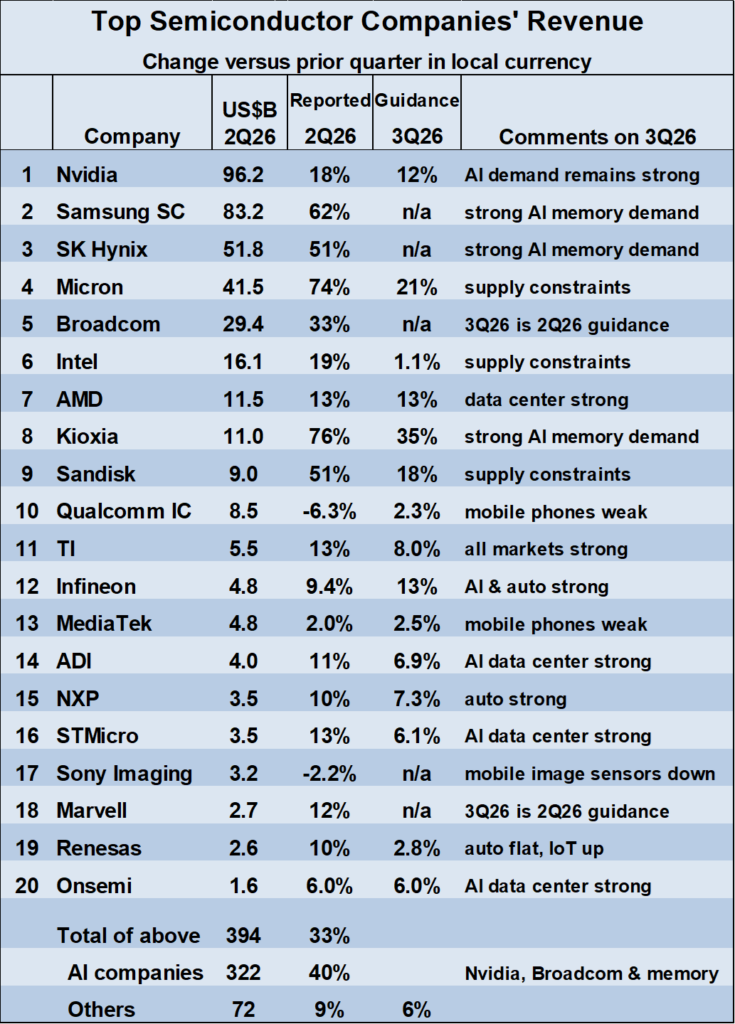
Several of the world’s largest memory suppliers reported dramatic sequential revenue increases in their latest quarters. Kioxia reported quarterly revenue of ¥1.77 trillion for the three months ended June 30, up approximately 76% from the previous quarter. The company attributed the increase primarily to significantly higher average selling prices driven by strong demand from generative-AI data-center customers. Its SSD and storage revenue nearly doubled sequentially, reaching ¥1.17 trillion. Micron Technology reported fiscal third-quarter revenue of $41.46 billion, compared with $23.86 billion in the previous quarter — an increase of approximately 74%. Micron said its record results reflected the growing strategic importance of memory in AI infrastructure.
SK hynix generated revenue of KRW 79.3 trillion during Q2 2026, up 51% sequentially and 257% year-over-year. The company said high-value products including HBM, AI server DRAM and enterprise SSDs helped drive the record performance. Sandisk also reported 51% sequential revenue growth, reaching $8.97 billion in its fiscal fourth quarter. Compared with a year earlier, quarterly revenue increased an extraordinary 372%. Its data-center business has become an increasingly important growth engine, with full-year data-center revenue increasing 437%.
Although these companies operate on slightly different fiscal calendars, their results demonstrate the same underlying trend: memory demand and pricing have accelerated rapidly as AI infrastructure expands.
Much of the attention surrounding AI memory has focused on High Bandwidth Memory, which sits alongside GPUs and other AI accelerators and provides the enormous memory bandwidth required for training and inference. SK hynix has already begun mass shipments of HBM4, while Micron is shipping HBM4 in high volume for its lead customer and developing HBM4E for production in 2027. But the semiconductor boom is no longer limited to HBM.
SK hynix says demand for both AI-specific memory and conventional memory is now expanding simultaneously. AI servers require large quantities of conventional DRAM, while the growth of inference workloads is increasing demand for high-capacity NAND flash and enterprise SSDs.
Kioxia similarly reported that demand from smartphone and PC customers remained stable while AI-server demand from data-center and enterprise customers continued to increase.
This broadening demand is particularly important because it means the AI investment cycle is beginning to affect a much larger portion of the memory market.
The demand driving memory suppliers is also visible at the processor level. NVIDIA reported $96.2 billion in quarterly revenue for its fiscal second quarter ended July 26, 2026, an increase of 18% sequentially and 106% year-over-year. Its Data Center business alone generated $89 billion, up 117% from a year earlier. The continued expansion of GPU shipments has significant implications throughout the semiconductor supply chain. Every additional AI accelerator deployment requires supporting memory, networking, power management, advanced packaging, substrates and semiconductor manufacturing capacity. This is one reason the AI investment cycle is creating growth well beyond companies directly manufacturing GPUs.
Despite the spectacular headline numbers, the semiconductor boom is not equally distributed across the industry. Semiconductor Intelligence estimates that, excluding several major AI and memory suppliers, the other companies among the world’s top semiconductor vendors collectively grew revenue by a much more moderate 9% sequentially during Q2.
This distinction is important. The current semiconductor expansion is heavily concentrated around:
→ AI accelerators
→ Memory
→ Data-center infrastructure
→ Advanced packaging
→ High-speed networking
Other semiconductor markets are recovering, but at considerably lower growth rates. Automotive and industrial markets remain comparatively healthy, while PCs and smartphones continue to face more challenging conditions. The result is effectively a two-speed semiconductor market, where companies directly exposed to AI infrastructure are growing at dramatically higher rates than many traditional chip suppliers.
The extraordinary first-half performance has pushed semiconductor-market expectations sharply higher. WSTS originally forecast in its Spring 2026 outlook that the global semiconductor market would grow approximately 90% to around $1.51 trillion this year. After replacing its forecast Q2 figures with actual results, WSTS calculated that the market could reach approximately $1.655 trillion in 2026, equivalent to growth of around 108% year-over-year. The equivalent calculation for 2027 suggests the industry could reach approximately $2.1 trillion, representing another 29% increase. WSTS stresses that these figures are not a completely new forecast scenario; they are calculations using actual Q2 results while maintaining the assumptions from its Spring forecast for subsequent quarters.
The biggest change is once again memory. WSTS’s original Spring forecast expected memory semiconductor revenue to increase roughly 250% during 2026. After incorporating the stronger-than-expected first half, the calculation now points to approximately 302% annual memory growth. This would make memory by far the largest contributor to semiconductor-industry expansion during 2026. The scale of the increase also illustrates how dramatically the economics of the memory industry have changed. Historically, DRAM and NAND have been highly cyclical commodity markets characterized by periods of oversupply followed by price collapses. The current AI cycle is introducing longer-term supply agreements, increasing demand for specialized memory and pushing memory closer to the center of system architecture.
The extraordinary sequential growth rates reported in Q2 are unlikely to continue indefinitely. Several memory suppliers are already guiding toward slower sequential growth in their coming quarters. Micron expects approximately $50 billion in fiscal Q4 revenue, compared with $41.46 billion in the previous quarter. Kioxia expects revenue of approximately ¥2.39 trillion in the September quarter, representing around 35% sequential growth — still extremely strong, but below its approximately 76% growth during the previous quarter.
Sandisk expects revenue between $10.3 billion and $10.8 billion in its next quarter, compared with $8.97 billion previously. The direction therefore remains positive, although the explosive growth rates experienced during the first half of 2026 are beginning to normalize.
Previous semiconductor growth cycles were largely associated with major new computing platforms. Personal computers drove semiconductor demand in the 1980s and 1990s. Smartphones transformed the industry during the 2010s.
AI infrastructure is now emerging as the next major semiconductor demand platform — but with one important difference. AI systems require massive semiconductor content across multiple technologies simultaneously: GPUs, custom ASICs, HBM, DRAM, NAND, networking chips, power semiconductors and advanced packaging. This makes the current expansion unusually broad across the infrastructure surrounding AI computing.
The first half of 2026 therefore represents more than simply another memory-market recovery. With worldwide semiconductor revenue already exceeding $700 billion in six months and memory sales growing more than 300%, AI is fundamentally changing both the scale and composition of the global semiconductor market.