



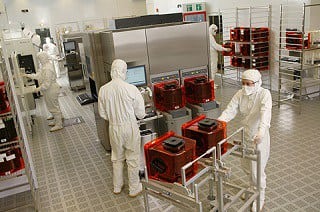
Semiconductor Manufacturing International Corporation (SMIC) delivered a strong second quarter of 2026, with quarterly revenue surpassing $3 billion for the first time, supported by higher wafer shipments, improving wafer prices and continued high utilization across its manufacturing network.
SMIC reported Q2 2026 revenue of $3.006 billion, representing a 20.0% increase quarter-over-quarter and a 36.1% increase year-over-year. Gross profit reached $760.6 million, up 51.0% sequentially and 69.1% compared with Q2 2025.
Gross margin also improved significantly, rising to 25.3%, compared with 20.1% in the previous quarter and 20.4% one year earlier.
The performance reflects increasingly tight semiconductor manufacturing capacity, particularly as AI-related demand creates additional requirements not only for processors and accelerators, but also for the large ecosystem of power-management, connectivity, interface and supporting chips required around AI systems. SMIC management said the spillover effects from AI are expected to continue supporting broad semiconductor manufacturing demand during the second half of 2026.
| Metric | Q2 2026 | Q1 2026 | Q2 2025 | QoQ | YoY |
|---|---|---|---|---|---|
| Revenue | $3.006B | $2.505B | $2.209B | +20.0% | +36.1% |
| Gross Profit | $760.6M | $503.6M | $449.8M | +51.0% | +69.1% |
| Gross Margin | 25.3% | 20.1% | 20.4% | +5.2 pts | +4.9 pts |
| Operating Profit | $534.2M | $247.8M | $150.7M | +115.6% | +254.5% |
| Profit Attributable to Owners | $479.2M | $197.4M | $132.5M | +142.7% | +261.7% |
| Wafer Shipments* | 2.869M | 2.509M | 2.390M | +14.4% | +20.1% |
| Utilization | 93.7% | 93.1% | 92.5% | — | — |
*Standard logic 8-inch-equivalent wafers.
A particularly important part of SMIC’s Q2 performance was that revenue growth came from both volume and pricing. SMIC shipped approximately 2.87 million 8-inch-equivalent wafers during the quarter, an increase of 14.4% compared with Q1 and 20.1% compared with the same period last year. At the same time, average wafer selling prices increased by approximately 5.7% sequentially, according to comments following the earnings release. SMIC management said the company had negotiated higher pricing with customers in areas where manufacturing capacity is particularly tight, with the new pricing affecting wafers processed during the third quarter.
The combination of increased shipments and improved pricing helps explain why revenue grew 20% while wafer shipments increased 14.4%. This is significant for the foundry market because high utilization alone does not necessarily translate into higher profitability when depreciation expenses are increasing. Improving wafer pricing provides foundries with an important mechanism for absorbing the growing cost associated with new manufacturing capacity.
SMIC’s overall utilization rate increased from 93.1% in Q1 to 93.7% in Q2, compared with 92.5% one year earlier. Operating a foundry consistently above 90% utilization generally provides stronger absorption of fixed manufacturing expenses, particularly depreciation. SMIC has been investing heavily in additional manufacturing capacity, meaning depreciation and amortization expenses continue to increase. Manufacturing-related depreciation and amortization reached approximately $924.8 million during Q2, up 23.1% year-over-year. Total depreciation and amortization reached approximately $1.21 billion. Despite these higher costs, SMIC’s gross margin expanded sharply to 25.3%. Management attributed the improvement primarily to higher average selling prices, improved product mix and stronger-than-expected utilization, which more than compensated for rising depreciation expenses.
One of the more interesting observations from SMIC’s earnings discussion is that the AI semiconductor opportunity extends considerably beyond advanced processors. Management said the increase in wafer shipments was driven primarily by rapidly growing AI-related demand for chips outside traditional CPU and GPU categories, particularly from China-based customers. These supporting semiconductor categories can include power-management ICs, controllers, connectivity devices, interface chips, mixed-signal products and other components required around AI computing infrastructure. During the earnings call, SMIC indicated that revenue related to AI-supporting products, computers and tablets, and industrial and automotive applications increased by roughly 40% sequentially in absolute dollar terms.
This demonstrates an important semiconductor market trend: AI infrastructure growth can create additional demand across both advanced and mature process technologies.
Consumer electronics represented the largest portion of SMIC’s wafer revenue during Q2.
The application mix was:
Consumer Electronics: 44.2%
Smartphones: 16.9%
Industrial and Automotive: 16.5%
Computer and Tablet: 15.6%
Connectivity and IoT: 6.8%
Industrial and automotive increased from 14.0% of wafer revenue in Q1 to 16.5% in Q2, while computer and tablet increased from 13.6% to 15.6%. Although smartphones represented a smaller percentage of total revenue than in Q1, management indicated that smartphone revenue still increased in absolute terms because the company’s overall revenue expanded substantially during the quarter.
SMIC’s manufacturing mix is also increasingly weighted toward 12-inch wafers.
During Q2:
12-inch wafers represented 78.2% of wafer revenue, compared with 76.4% in Q1 and 76.1% in Q2 2025.
Eight-inch wafers accounted for the remaining 21.8%.
SMIC’s total monthly production capacity reached approximately 1.097 million standard logic 8-inch-equivalent wafers, compared with 1.078 million in the previous quarter.
The company added approximately 8,000 wafers per month of additional 12-inch capacity during Q2, according to management.
Another notable change is the increasing concentration of SMIC’s business in China. China accounted for 90.2% of Q2 revenue, compared with 88.9% in Q1 and 84.1% one year earlier.
Revenue distribution by geography was:
| Geography | Q2 2026 | Q1 2026 | Q2 2025 |
|---|---|---|---|
| China | 90.2% | 88.9% | 84.1% |
| America | 8.2% | 9.3% | 12.9% |
| Eurasia | 1.6% | 1.8% | 3.0% |
The figures show how strongly SMIC’s growth is becoming tied to China’s domestic semiconductor ecosystem.
SMIC spent $1.836 billion on capital expenditure during Q2, compared with $1.563 billion during the first quarter. Combined first-half capital expenditure therefore reached approximately $3.4 billion. The investment is being used to expand manufacturing capacity while SMIC simultaneously works to qualify newly installed equipment and production lines. High capital expenditure inevitably creates additional depreciation pressure. Management expects full-year depreciation and amortization to continue increasing substantially as new capacity enters production. However, with utilization already approaching 94%, the company appears to be bringing new manufacturing capacity into a market where significant demand already exists.
SMIC’s headline profit numbers were extremely strong. Profit attributable to owners increased 261.7% year-over-year to $479.2 million, while total profit for the period reached $733.2 million. However, not all of this increase came directly from semiconductor manufacturing operations. SMIC recorded approximately $275.9 million of other income during Q2, compared with just $7.5 million in Q1. This included approximately $193.8 million from the share of profits of associates and a joint venture, as well as gains associated with investment valuations. The underlying manufacturing improvement was nevertheless substantial: operating profit increased to $534.2 million, more than double the previous quarter and more than triple the level reported one year earlier.
SMIC expects momentum to continue during the third quarter.
The company guided for:
Revenue growth of 2% to 4% quarter-over-quarter
and
Gross margin of 26% to 28%.
Based on Q2 revenue, this guidance implies quarterly revenue of approximately $3.07 billion to $3.13 billion, potentially setting another record quarter. Management also expects utilization to remain around the mid-90% range even as additional manufacturing capacity becomes available.
SMIC’s Q2 2026 results provide another indication that the AI semiconductor cycle is spreading well beyond the companies manufacturing leading-edge AI processors. Higher demand for AI infrastructure is creating requirements for large numbers of supporting semiconductor devices, many of which can be manufactured on mature and specialty process technologies. That dynamic is contributing to higher utilization, increased wafer shipments and stronger pricing across parts of the foundry market. For SMIC, the combination was particularly powerful during Q2: wafer shipments increased 14.4%, average wafer prices improved, utilization reached 93.7%, and revenue jumped 20% in only one quarter.
With SMIC now guiding for another sequential increase in revenue and gross margin during Q3, the company’s results suggest that foundry capacity tightness may remain an important semiconductor industry theme through the second half of 2026.
And perhaps the most important takeaway is that this demand is not limited to advanced AI GPUs.
The expansion of AI infrastructure is increasingly pulling demand through a much broader semiconductor supply chain — including power management, mixed-signal, connectivity, controllers, industrial devices and other chips built on mature and specialty manufacturing technologies.