


Semiconductor Manufacturing International Corporation (SMIC) is one of the most important companies in the development of China’s semiconductor industry. Founded in Shanghai in 2000 by Taiwanese semiconductor executive Richard Chang, SMIC emerged with an ambitious objective: to establish a world-class semiconductor foundry capable of competing with established manufacturers such as Taiwan Semiconductor Manufacturing Company (TSMC).
The company’s history reflects China’s determination to develop domestic semiconductor manufacturing capabilities and reduce its dependence on foreign technology. During its early years, SMIC attracted international investors, recruited experienced engineers from Taiwan and the United States, and rapidly expanded its manufacturing operations. By the end of the 2000s, the company had become one of China’s most technologically advanced semiconductor manufacturers.
However, its development also revealed the enormous challenges associated with building a competitive semiconductor foundry. Despite considerable investments, international technology partnerships and government support, SMIC struggled to match the manufacturing capabilities of leading competitors. Intellectual property disputes, financial difficulties, increasing government involvement and restrictions on access to advanced semiconductor equipment all influenced its development.
The history of SMIC illustrates how semiconductor manufacturing became not only an important commercial industry but also a strategic priority for governments seeking technological and economic independence.
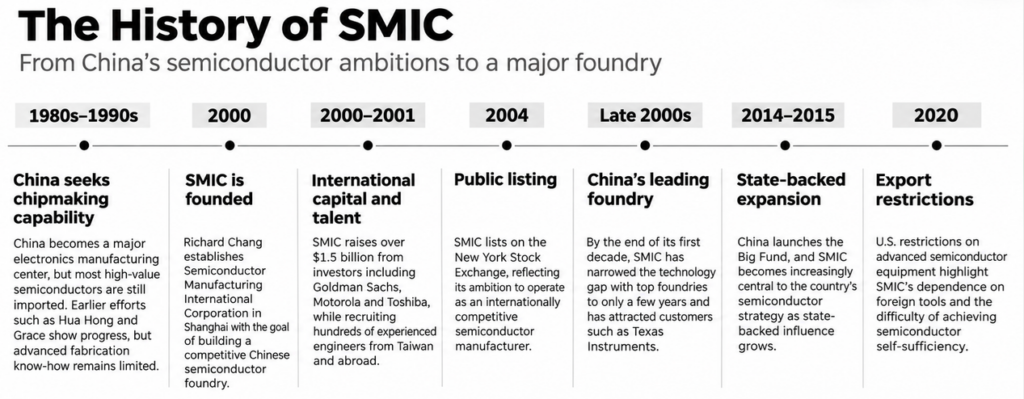
The origins of SMIC can be traced to China’s economic transformation during the 1980s and 1990s. As the country opened its economy to foreign investment, multinational electronics companies increasingly established manufacturing operations in Chinese cities such as Shanghai and Shenzhen.
China rapidly became one of the world’s largest centers for electronics assembly. International companies took advantage of its growing industrial infrastructure and relatively inexpensive labor to manufacture computers, telecommunications equipment and consumer electronics.
However, much of the value in these products came from semiconductor components manufactured elsewhere. While Chinese factories assembled increasingly sophisticated electronic devices, the processors, memory chips and other integrated circuits used in those products were largely supplied by foreign semiconductor companies.
Chinese policymakers recognized that the country needed to develop its own semiconductor manufacturing capabilities to capture more of the value generated by the electronics industry.
Several earlier attempts to establish domestic semiconductor production had achieved limited results. Although China had invested in semiconductor research and manufacturing during previous decades, its fabrication capabilities remained considerably behind those of the United States, Japan, Taiwan and South Korea.
One approach involved forming joint ventures with foreign semiconductor manufacturers. In Shanghai, Chinese company Hua Hong established a manufacturing partnership with Japan’s NEC, providing an opportunity to establish advanced fabrication operations.
However, the arrangement did not deliver the level of technology transfer that Chinese officials had hoped for. Japanese engineers retained control over the most sophisticated manufacturing activities, while Chinese employees were largely assigned more basic responsibilities.
Another semiconductor manufacturer, Grace Semiconductor, was established in Shanghai in 2000 with financial and political support. Despite its connections and investment, the company struggled to acquire advanced technology and attract a significant customer base.
China had demonstrated that it could finance semiconductor fabrication facilities, but building a competitive manufacturing industry required something more difficult to acquire: experienced engineers and sophisticated process knowledge.
The founding of SMIC is closely associated with Richard Chang, a semiconductor manufacturing executive whose career had been shaped by the international expansion of the electronics industry.
Chang was born in Nanjing, China, in 1948. Following the Communist victory in the Chinese Civil War, his family moved to Taiwan when he was still an infant.
After completing his university education, Chang moved to the United States, where he earned a graduate degree in Buffalo, New York. He subsequently joined Texas Instruments, one of the pioneers of integrated circuit technology.
At Texas Instruments, Chang worked alongside engineers who had contributed to the early development of the semiconductor industry, including Jack Kilby, one of the inventors of the integrated circuit.
Chang developed extensive expertise in semiconductor manufacturing and became involved in establishing and operating fabrication facilities in different countries.
His responsibilities took him to semiconductor operations in the United States, Japan, Singapore and Italy, giving him practical experience in the technological and organizational challenges associated with building manufacturing facilities.
This international experience shaped his understanding of how semiconductor industries could develop. He recognized that successful chip manufacturing depended not simply on purchasing sophisticated equipment but also on recruiting knowledgeable engineers, implementing effective manufacturing processes and continuously improving production yields.
By the late 1990s, Chang believed that China was ready to develop a semiconductor manufacturing industry capable of competing internationally.
Shanghai, with its growing industrial economy and access to international investment, provided a promising location.
In 2000, Chang established Semiconductor Manufacturing International Corporation with the objective of building a competitive semiconductor foundry in China.
SMIC was founded at a time when the semiconductor industry was undergoing a significant transformation.
Traditionally, major semiconductor companies had designed and manufactured their own integrated circuits. Companies such as Intel, Texas Instruments and Motorola operated fabrication facilities dedicated primarily to producing their own semiconductor products.
However, the success of TSMC had demonstrated the advantages of a different business model. Rather than developing semiconductor products of its own, a dedicated foundry could manufacture chips designed by external customers.
This arrangement allowed fabless semiconductor companies to concentrate on chip design without making the enormous investments required to establish fabrication facilities.
Richard Chang understood the commercial potential of this model and sought to establish a similar manufacturing business in China.
SMIC attracted substantial international financing during its early development. The company raised more than $1.5 billion from investors that included Goldman Sachs, Motorola and Toshiba.
One contemporary estimate suggested that approximately half of the company’s initial investment capital came from American investors.
The involvement of major international companies demonstrated the commercial interest in developing additional semiconductor manufacturing capacity in Asia.
For semiconductor design companies, the emergence of SMIC offered the possibility of another manufacturing partner capable of competing with established foundries on price, capacity and technology.
For China, SMIC represented an opportunity to develop domestic semiconductor fabrication expertise rather than remaining dependent on foreign manufacturers.
One of Richard Chang’s most important decisions was to recruit experienced semiconductor engineers from outside China.
He understood that advanced manufacturing knowledge could not be acquired simply by purchasing semiconductor fabrication equipment. Engineers needed to understand the complicated relationships between process parameters, materials, manufacturing defects and production yields.
SMIC therefore recruited aggressively from established semiconductor companies, particularly those operating in Taiwan and the United States.
During its early development, the company hired at least 400 engineers from Taiwan, many of whom brought experience from semiconductor manufacturers with sophisticated production capabilities.
In 2001, SMIC employed approximately 650 locally recruited engineers alongside 393 engineers hired from overseas.
Throughout much of its first decade, approximately one-third of its engineering workforce had been recruited internationally.
This strategy helped the company transfer practical manufacturing knowledge to its domestic workforce. Experienced engineers trained local employees, introduced established manufacturing practices and helped improve the company’s production capabilities.
The company emphasized the importance of experienced personnel mentoring newer employees so that technical expertise could be transferred across the organization.
Over time, SMIC’s locally trained engineers developed increasingly sophisticated manufacturing skills. Some became sufficiently experienced to attract employment offers from international semiconductor companies.
This demonstrated that SMIC was not merely operating foreign equipment in China. It was developing a domestic engineering workforce capable of managing complex semiconductor manufacturing processes.
The approach became one of the company’s most important early achievements and provided a foundation for China’s broader semiconductor manufacturing ambitions.
Although SMIC attracted substantial private investment, government support also played an important role in its development.
Chinese authorities considered semiconductor manufacturing a strategically important industry and introduced financial incentives designed to encourage investment.
SMIC benefited from measures including a five-year corporate tax holiday and reduced sales taxes on semiconductors sold within China.
These policies reduced the financial burden associated with establishing fabrication facilities and helped the company compete with manufacturers operating elsewhere in Asia.
However, SMIC initially distinguished itself from some other Chinese semiconductor ventures through its emphasis on manufacturing quality and engineering expertise.
Rather than concentrating primarily on securing government financing, Richard Chang focused on expanding production capacity, recruiting experienced personnel and adopting semiconductor process technologies that approached international standards.
This strategy produced encouraging results.
By the end of the 2000s, SMIC had reduced its technological gap with the world’s leading semiconductor manufacturers to approximately a few years.
Although the company remained behind the most advanced foundries, its progress demonstrated that China could establish competitive semiconductor manufacturing capabilities through a combination of international investment, experienced personnel and government support.
SMIC also began attracting major international customers, including Texas Instruments, where Chang had previously worked.
These manufacturing contracts strengthened the company’s commercial credibility and demonstrated its ability to serve established semiconductor manufacturers.
In 2004, SMIC listed its shares on the New York Stock Exchange, representing an important milestone in its development as an international semiconductor manufacturer.
The listing reflected the company’s early ambition to operate as a commercially competitive foundry with access to global capital markets.
It also provided additional visibility among international investors and semiconductor industry participants.
During this period, the global foundry industry was expanding rapidly. TSMC remained the dominant contract manufacturer, but several other companies were attempting to establish competitive positions.
Taiwan’s UMC and Vanguard Semiconductor, Singapore’s Chartered Semiconductor and South Korea’s Samsung were among the manufacturers competing to produce chips designed by external customers.
The expansion of foundry manufacturing benefited fabless semiconductor companies, particularly those based in the United States.
As manufacturing capacity expanded and competition increased, semiconductor designers gained access to more potential suppliers.
This reduced barriers to entry for companies developing new integrated circuits and supported the growth of the fabless semiconductor business model.
SMIC became an important participant in this international manufacturing ecosystem, offering an additional source of wafer fabrication capacity in China.
Despite its early progress, SMIC faced substantial challenges in competing with TSMC.
TSMC had established a powerful position in semiconductor contract manufacturing by attracting major international customers, maintaining advanced process development programs and continuously expanding its production capacity.
Its large customer base provided significant economic advantages. The company could spread its research, equipment and fabrication costs across enormous semiconductor production volumes.
SMIC had a much smaller manufacturing base and fewer financial resources.
Although the company had made rapid technological progress during its first decade, the continuing development of semiconductor processes required increasingly expensive equipment and research.
The transition toward smaller transistors introduced additional manufacturing difficulties. Each new process generation demanded improvements in lithography, deposition, etching and other manufacturing operations.
For SMIC, keeping pace with technological developments required continuous investments at a scale that was difficult to finance through commercial operations alone.
The company also became involved in a series of intellectual property disputes with TSMC.
These legal conflicts created additional financial and organizational difficulties for SMIC, complicating its efforts to establish itself as a credible competitor in the international foundry industry.
Although Richard Chang had successfully developed the company’s manufacturing capabilities, SMIC struggled to achieve consistent profitability.
Eventually, Chang was removed from his leadership position, marking a significant change in the company’s direction.
The early ambition to create an internationally competitive foundry increasingly became intertwined with China’s broader industrial development objectives.
Following Richard Chang’s departure, SMIC’s ownership and management gradually became more closely connected to the Chinese government.
Private-sector investors lost influence as state-backed institutions assumed a more prominent role in the company’s development.
By 2015, a former official from China’s Ministry of Industry and Information had become chairman of SMIC, reinforcing the relationship between the company and the country’s industrial policy.
This transformation reflected a broader change in China’s semiconductor strategy.
Chinese policymakers were increasingly concerned about the country’s dependence on foreign semiconductor technology.
Although China had become one of the world’s largest electronics manufacturing centers, it continued to import enormous quantities of semiconductor components.
The country’s technology companies relied on foreign suppliers for advanced processors, memory chips, semiconductor design software and manufacturing equipment.
As demand for cloud computing, telecommunications equipment and artificial intelligence increased, this dependence became more strategically significant.
Chinese authorities concluded that developing domestic semiconductor manufacturing capabilities required much greater financial support.
SMIC, as one of China’s most technologically advanced foundries, became an important part of this effort.
In 2014, China launched a major semiconductor investment initiative commonly known as the Big Fund.
The program was designed to support the development of domestic semiconductor companies through substantial financial investments.
Its investors included China’s Ministry of Finance, the state-owned China Development Bank and investment organizations associated with regional governments.
The initiative reflected the rapidly increasing cost of semiconductor manufacturing.
By the middle of the 2010s, building an advanced semiconductor fabrication facility could require investments exceeding $10 billion.
These costs made it extraordinarily difficult for smaller manufacturers to compete with established international foundries.
SMIC’s annual revenue during much of the 2010s amounted to only a few billion dollars, less than one-tenth of TSMC’s revenue.
This difference created a significant financial disadvantage.
TSMC could invest enormous sums in advanced process development, manufacturing equipment and production capacity, while SMIC had much more limited commercial resources.
Government financing offered a potential way to narrow the gap.
However, financial investment alone could not guarantee technological progress. The experience of several earlier Chinese semiconductor ventures had shown that government subsidies could encourage the construction of fabrication facilities without necessarily producing competitive manufacturing capabilities.
Developing advanced semiconductor technology required effective management, experienced personnel, reliable supply chains and sustained process innovation.
The challenge for SMIC was therefore not simply obtaining sufficient capital but also turning that investment into competitive semiconductor manufacturing technology.
The development of SMIC became increasingly connected to China’s ambition to reduce dependence on imported semiconductor technology.
Under its Made in China 2025 industrial strategy, the Chinese government established ambitious objectives for increasing the domestic production of semiconductor components.
The plan envisioned reducing the proportion of chips supplied through imports from approximately 85% in 2015 to 30% by 2025.
These figures represented policy objectives rather than achieved results.
The strategy reflected growing concerns about the country’s reliance on foreign technology, particularly as semiconductors became essential to telecommunications infrastructure, computing systems and advanced industrial equipment.
For China, semiconductor manufacturing was no longer simply a commercial opportunity.
It had become an issue involving industrial competitiveness, economic development and national security.
SMIC occupied a central position in this strategy because it had already demonstrated an ability to manufacture sophisticated logic semiconductors and develop an experienced domestic engineering workforce.
However, achieving technological independence remained difficult.
China’s semiconductor manufacturers continued to depend on foreign suppliers for essential manufacturing equipment, design tools and process technologies.
Even when semiconductor fabrication took place within China, many of the machines and software systems required for production originated from companies based in the United States, Japan and Europe.
This dependence would become increasingly important as international trade restrictions began affecting China’s access to advanced semiconductor technology.
During the 2000s, SMIC benefited from relatively open international trade in semiconductor manufacturing equipment.
The United States initially pursued policies that encouraged commercial relationships and investment with China’s technology industry.
SMIC even received a special classification as a validated end-user, indicating that American authorities considered it eligible for exemptions from certain export restrictions.
This arrangement reflected the expectation that international trade and investment could support China’s integration into the global semiconductor industry.
However, the relationship changed significantly as tensions between the United States and China increased.
American policymakers became more concerned about the potential military applications of advanced semiconductor technology and China’s efforts to develop independent manufacturing capabilities.
Semiconductor manufacturing equipment became an important focus of these concerns.
Although semiconductor fabrication had expanded across Asia, American companies continued to supply essential equipment, software and technologies used throughout the global manufacturing process.
This created a strategic vulnerability for Chinese chipmakers.
Even companies operating fabrication facilities entirely within China depended on foreign technology to manufacture advanced integrated circuits.
By 2020, the United States had introduced increasingly restrictive measures affecting Chinese technology companies, particularly Huawei.
Restrictions were extended to certain semiconductor products manufactured outside the United States when American-origin technology or equipment was involved.
The measures demonstrated how control over critical semiconductor manufacturing technologies could influence access to the global chip supply chain.
SMIC was also affected by new restrictions on its ability to purchase advanced semiconductor manufacturing equipment.
Although the company remained operational, the limitations created additional obstacles to closing the technological gap with leading international foundries.
The restrictions also highlighted the difficulty of achieving semiconductor self-sufficiency in an industry characterized by highly specialized international supply chains.
As the semiconductor industry continued developing smaller transistor geometries, SMIC faced an important technological and commercial challenge.
The world’s leading logic semiconductor manufacturers were investing heavily in increasingly sophisticated fabrication processes.
Advanced process nodes required extremely precise manufacturing equipment, sophisticated lithography systems and enormous capital investments.
Only a small number of companies possessed the financial resources and engineering expertise required to remain at the leading edge.
However, not every semiconductor application required the latest process technology.
Many automotive, industrial and consumer electronic products depended on integrated circuits manufactured using established semiconductor processes.
These technologies often provided sufficient performance at significantly lower manufacturing costs.
For applications such as control electronics and other specialized functions, process reliability, cost and long-term availability could be more important than achieving the highest possible transistor density.
This created opportunities for semiconductor manufacturers that were not competing at the most advanced process nodes.
SMIC had already demonstrated that China could develop competitive manufacturing capabilities for established logic technologies.
As international restrictions complicated access to advanced manufacturing equipment, established process technologies became an increasingly important area of investment.
During this period, much of China’s planned semiconductor fabrication expansion concentrated on production capacity using older process generations.
For SMIC, these technologies offered a practical opportunity to expand manufacturing capacity, serve domestic demand and compete internationally without requiring the same level of investment as the most advanced logic processes.
The history of SMIC illustrates several fundamental characteristics of the semiconductor foundry industry.
First, semiconductor manufacturing requires enormous capital investment. Fabrication facilities must be equipped with sophisticated machinery capable of performing hundreds of tightly controlled manufacturing operations.
Second, technological expertise is essential. Manufacturing yields, process stability and production efficiency depend on engineering knowledge developed through years of experience.
Third, production scale creates major competitive advantages. Foundries with large customer bases can distribute their equipment and research expenses across greater manufacturing volumes.
These factors help explain why a relatively small number of companies dominate the most advanced semiconductor manufacturing technologies.
SMIC successfully acquired international expertise, developed domestic engineering capabilities and established substantial semiconductor fabrication operations.
Nevertheless, competing with TSMC required financial resources and manufacturing volumes that were difficult to achieve.
The company’s experience also demonstrates the limitations of government subsidies.
Financial support can accelerate the construction of fabrication facilities and reduce investment costs, but it cannot immediately reproduce the manufacturing expertise accumulated by established semiconductor leaders.
At the same time, the expansion of established-node manufacturing can provide commercially valuable capabilities without requiring the development of the smallest available transistor technologies.
The semiconductor manufacturing industry therefore supports several different business strategies, ranging from leading-edge logic production to the fabrication of established and specialized semiconductor devices.
SMIC represents an important stage in the development of China’s semiconductor manufacturing industry.
Before the company’s establishment, China’s participation in the semiconductor supply chain was concentrated heavily on electronics assembly and manufacturing activities involving relatively limited technological complexity.
The creation of SMIC demonstrated that China could attract international semiconductor investment, recruit experienced engineers and develop sophisticated wafer fabrication capabilities.
Richard Chang’s strategy of combining international expertise with local workforce development proved particularly important.
By the end of its first decade, SMIC had developed manufacturing capabilities that placed it within a few years of the industry’s leading process technologies.
Although subsequent financial, technological and organizational challenges prevented the company from establishing technological parity with TSMC, SMIC became one of China’s most successful domestic semiconductor manufacturing ventures.
Its history also reflects the changing international environment surrounding semiconductor production.
During its early years, the company benefited from foreign investment, international recruitment and relatively open access to semiconductor manufacturing technology.
Over time, increasing government involvement and international trade restrictions transformed its operating environment.
The company became a central participant in China’s attempts to strengthen domestic semiconductor production while facing the challenges created by dependence on foreign manufacturing equipment and technology.
These developments demonstrate how semiconductor manufacturing evolved from an industry primarily concerned with technological innovation and commercial competition into one with substantial geopolitical significance.
The history of Semiconductor Manufacturing International Corporation illustrates both the opportunities and the difficulties associated with building a competitive semiconductor foundry.
Founded in Shanghai in 2000 by Richard Chang, SMIC began as an internationally financed manufacturing venture seeking to replicate the success of Taiwan’s semiconductor foundry industry.
Through aggressive recruitment, international investment and government support, the company established significant manufacturing capabilities and helped develop China’s domestic semiconductor engineering workforce.
However, competing with established manufacturers such as TSMC proved considerably more difficult than constructing fabrication facilities.
The enormous cost of advanced process development, the importance of manufacturing scale, intellectual property disputes and increasing restrictions on access to foreign technology all influenced the company’s development.
SMIC’s evolution from a commercially oriented foundry into a strategically important part of China’s semiconductor industrial policy reflects broader changes in the global semiconductor industry.
Its experience demonstrates that building a successful semiconductor manufacturing industry requires more than capital investment. It depends on technological expertise, reliable manufacturing processes, access to specialized equipment and the ability to compete within a complex international supply chain.
Ultimately, SMIC’s story is an important chapter in the development of global semiconductor manufacturing, illustrating China’s efforts to establish domestic chip production capabilities and the technological, economic and political challenges involved in competing with the world’s leading foundries.