

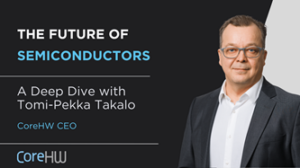
This interview features: Tomi-Pekka Takalo, CEO and co-founder at CoreHW.
Can you describe your company’s founding vision and how it has evolved to address the changing landscape of the semiconductor industry?
CoreHW was founded in 2013 by RF engineers with a vision to deliver high-quality custom
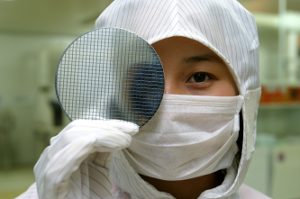
The ams OSRAM 2026 MPW (Multi-Project Wafer) program expands its technology offering with new 180nm options, including the C18 CMOS specialty platform further enriching the MPW portfolio. For mixed-signal designs in mature nodes, this extension delivers strong analog, high-voltage and BCD capabilities tailored to customer needs.
The MPW program
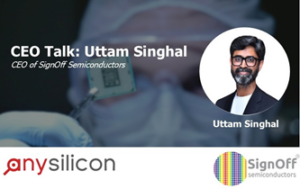
This interview features: Uttam Singhal, CEO, SignOff Semiconductors Pvt. Ltd.
Tell me a bit about your background? How did you first get started with your company?
I have spent over 25 years in the semiconductor industry, beginning my career in full-custom analog and memory design before transitioning

Choosing between 28nm, 40nm, and 65nm is one of the most common — and most underestimated — decisions in ASIC development.
These nodes dominate industrial, automotive, consumer, and IoT ASICs, yet teams often choose based on habit or outdated assumptions. In reality, the differences between 28nm, 40nm, and 65nm
Choosing a 22nm process node is not just a scaling decision — it is a strategic choice that affects power consumption, cost structure, ecosystem access, and long-term product risk.
For many ASIC and SoC teams, 22nm sits at the crossroads between mature nodes (28nm/40nm) and more advanced, higher-risk technologies.
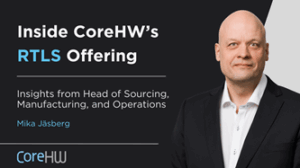
In this exclusive interview, Mika Jäsberg, Head of Sourcing, Manufacturing, and Operations at CoreHW, shares insights into the company’s next-generation real-time location system (RTLS). He discusses CoreRTLS Tag series, CoreRTLS-LOC4000, and CoreRTLS software—highlighting innovations in accuracy, scalability, and security that position CoreHW as a leader in location intelligence technology.