


United Microelectronics Corporation (UMC) is one of the pioneering companies in Taiwan’s semiconductor industry and an important participant in the development of the global semiconductor foundry business. Established in 1980 with support from the Taiwanese government, UMC emerged during a period when Taiwan was attempting to transform its economy from low-cost electronics assembly into advanced semiconductor manufacturing.
The company’s history is closely connected to Taiwan’s rise as one of the world’s most important semiconductor manufacturing centers. Long before the island became synonymous with advanced chip production, its electronics industry depended heavily on foreign technology, international investment and the assembly of semiconductor devices manufactured elsewhere.
UMC was part of an ambitious effort to change that position. By establishing domestic wafer fabrication capabilities, Taiwan hoped to capture more of the value generated by semiconductor production and reduce its dependence on foreign manufacturers. Over the following decades, UMC developed into a major contract semiconductor manufacturer, competing with companies such as Taiwan Semiconductor Manufacturing Company (TSMC), GlobalFoundries and other international foundries.
The history of UMC illustrates how government industrial policy, technology transfer, manufacturing expertise and the emergence of fabless semiconductor companies helped transform the global semiconductor industry.
The origins of UMC can be traced to Taiwan’s efforts to develop an electronics industry during the 1960s and 1970s. At that time, semiconductor manufacturing was dominated by American companies, while several Asian economies were beginning to establish themselves as important locations for electronics assembly.
Taiwan’s early role in the semiconductor supply chain was primarily focused on labor-intensive manufacturing activities. Foreign companies shipped semiconductor devices to the island, where workers tested the chips and assembled them into plastic or ceramic packages before the finished components were exported to international customers.
This business provided employment and helped Taiwan develop a skilled industrial workforce. However, it captured only a relatively small portion of the profits generated by the semiconductor industry. The most valuable activities, including advanced chip design and wafer fabrication, remained concentrated in countries such as the United States.
One of the early foreign investors was Texas Instruments, which established semiconductor operations in Taiwan during the late 1960s. The company’s manufacturing activities helped train local engineers and demonstrated that Taiwan could become a reliable location for semiconductor production.
Taiwanese government officials, particularly economic policymaker K. T. Li, recognized that electronics manufacturing could become an important source of economic growth. However, they also understood that Taiwan would need to develop more sophisticated manufacturing capabilities to remain competitive.
South Korea was investing aggressively in advanced memory semiconductors, while Singapore and Malaysia were expanding their electronics industries. At the same time, China’s opening to foreign investment threatened Taiwan’s position in labor-intensive manufacturing because mainland China could offer substantially lower production costs.
To preserve its competitive position, Taiwan needed to move beyond semiconductor assembly and establish its own chip fabrication capabilities.
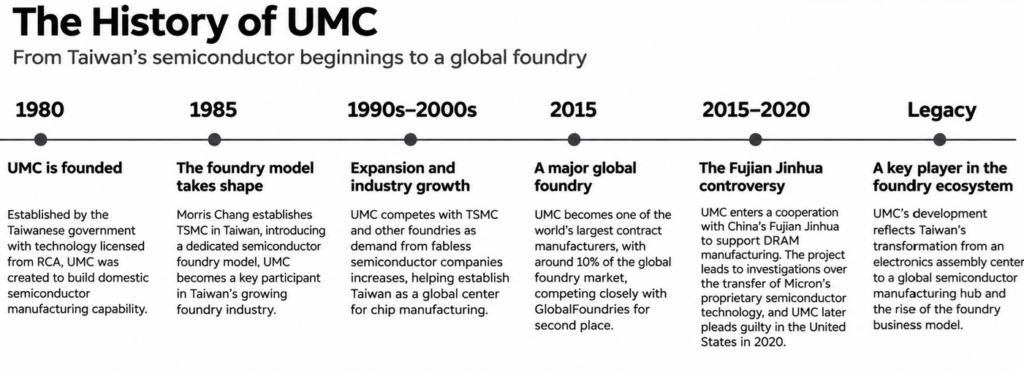
In 1980, the Taiwanese government established United Microelectronics Corporation as part of its strategy to develop a domestic semiconductor manufacturing industry.
The initiative involved licensing semiconductor manufacturing technology from RCA, an American electronics company with extensive experience in semiconductor development and production.
Technology transfer was essential because Taiwan did not yet possess the advanced fabrication processes, manufacturing equipment expertise or engineering experience required to compete independently with established semiconductor manufacturers.
Rather than developing every aspect of semiconductor manufacturing from the beginning, Taiwan sought to acquire existing technology and use it as the foundation for domestic production capabilities.
UMC became an important part of this strategy. By establishing a Taiwanese semiconductor manufacturer, the government hoped to accelerate the country’s transition from assembly operations toward the more valuable stages of semiconductor manufacturing.
However, building a semiconductor fabrication business was substantially more difficult than assembling electronic components. Producing integrated circuits required precise control of complex manufacturing processes, sophisticated equipment and extensive technical knowledge.
During its early years, UMC’s manufacturing capabilities remained significantly behind the world’s leading semiconductor producers. The company represented an important step forward for Taiwan’s industry, but the technological gap between domestic manufacturers and American semiconductor companies remained considerable.
Nevertheless, the creation of UMC demonstrated Taiwan’s determination to develop a semiconductor industry capable of competing internationally.
The establishment of UMC was part of a much broader industrial transformation. Taiwan’s government understood that semiconductor manufacturing required more than constructing fabrication facilities and importing equipment.
Successful semiconductor production depended on experienced engineers, reliable manufacturing processes, access to advanced technologies and the ability to improve production yields.
Semiconductor yield refers to the proportion of manufactured chips that meet the required specifications. Improving yields is particularly important because semiconductor fabrication involves many expensive manufacturing steps, and defective devices directly increase production costs.
Manufacturers that achieve higher yields can produce chips more economically, improve production efficiency and compete more effectively on price.
For Taiwan, developing this manufacturing knowledge represented one of the most significant barriers to entering the semiconductor industry.
Government officials therefore sought to attract experienced semiconductor engineers, establish relationships with international technology companies and strengthen domestic research organizations.
One of the most important institutions was the Industrial Technology Research Institute (ITRI), which played a central role in Taiwan’s efforts to acquire semiconductor knowledge and develop domestic industrial capabilities.
By the middle of the 1980s, Taiwan had already established a foundation for semiconductor manufacturing, but its industry still lacked the technological leadership and international market position of established manufacturers.
UMC was an early result of this effort, and the country’s next major semiconductor initiative would transform the structure of the industry.
During the early decades of semiconductor manufacturing, most major chip companies followed an integrated business model. Companies such as Intel, Texas Instruments and Motorola designed their own semiconductor products and manufactured them in their own fabrication facilities.
This approach gave manufacturers control over both circuit design and production technology, but it also required enormous capital investments.
As semiconductor devices became more complex, manufacturing facilities grew increasingly expensive. New process generations required more advanced equipment, increasingly precise manufacturing techniques and substantial research and development expenditure.
These rising costs created an opportunity for a different business model in which one company could specialize in designing semiconductor devices while another company manufactured them.
Morris Chang, a semiconductor executive with extensive experience at Texas Instruments, had considered this concept as early as the 1970s. He believed that demand for semiconductor devices would expand into numerous applications and that many companies developing electronic products would prefer to outsource chip manufacturing.
Chang also recognized that manufacturing companies serving multiple customers could achieve economies of scale by spreading the costs of fabrication facilities and advanced process development across a larger production volume.
When Chang moved to Taiwan in 1985 to lead the country’s semiconductor development efforts, he had an opportunity to implement this idea.
With financial support from the Taiwanese government and a technological partnership with Philips, Chang established TSMC as a manufacturer dedicated to producing semiconductor devices for external customers.
The development of this business model would have major consequences for UMC and the entire semiconductor industry.
The growth of TSMC helped establish Taiwan as a global center for semiconductor contract manufacturing. Its business model offered fabless semiconductor companies access to manufacturing capacity without requiring them to build and operate their own fabrication facilities.
For chip design companies, this represented a major change. Previously, companies without fabs often relied on integrated semiconductor manufacturers with spare production capacity.
These arrangements created several difficulties. Manufacturing customers could be assigned a lower priority than the manufacturer’s own products, while differences between fabrication processes complicated chip design and production planning.
A dedicated semiconductor foundry offered a more attractive alternative by concentrating on manufacturing customers’ designs rather than competing with them in the semiconductor product market.
UMC became one of the companies competing in this expanding foundry industry.
As the semiconductor market developed, Taiwan established a manufacturing ecosystem that combined wafer fabrication, engineering expertise, semiconductor design and close relationships with international customers.
This ecosystem benefited from growing demand among American fabless semiconductor companies, many of which preferred to concentrate their resources on design rather than financing expensive semiconductor manufacturing facilities.
The expansion of foundry services reduced barriers to entry for new semiconductor companies and supported the development of increasingly specialized chip designers.
For UMC, the transformation created opportunities to serve semiconductor customers beyond Taiwan, while also placing the company in direct competition with other contract manufacturers.
During the 1990s and 2000s, the semiconductor foundry market became increasingly competitive as companies in several Asian countries expanded their manufacturing operations.
TSMC emerged as the dominant contract semiconductor manufacturer, but other companies also sought to participate in the rapidly growing market.
In Taiwan, UMC and Vanguard Semiconductor competed for foundry customers. Singapore’s Chartered Semiconductor established itself as another important contract manufacturer, while South Korea’s Samsung entered the foundry business in 2005.
China also began building its own semiconductor manufacturing industry. In 2000, semiconductor executive Richard Chang founded Semiconductor Manufacturing International Corporation (SMIC), attracting substantial international investment and recruiting experienced engineers from Taiwan and other semiconductor-producing countries.
SMIC attempted to replicate several elements of the Taiwanese foundry model, including the acquisition of advanced manufacturing equipment, recruitment of foreign-trained engineers and close cooperation with international semiconductor customers.
Government support played an important role in the expansion of semiconductor manufacturing throughout the region. Tax incentives, financial assistance and industrial development policies helped companies reduce their manufacturing costs and attract investment.
These developments created more options for fabless semiconductor companies seeking external wafer manufacturing services.
As more foundries entered the market, semiconductor designers gained access to competing manufacturing providers, creating opportunities to reduce production costs and expand the range of companies capable of developing custom integrated circuits.
UMC was part of this expanding international manufacturing network, helping establish Taiwan as a major center for semiconductor contract fabrication.
By 2015, UMC had established itself as one of the world’s largest contract semiconductor manufacturers.
The company competed closely with GlobalFoundries for the position of the world’s second-largest foundry, with each accounting for approximately 10% of the global foundry market.
TSMC remained the dominant manufacturer, controlling more than half of the market, while Samsung represented a smaller share of external foundry sales despite its substantial overall semiconductor manufacturing capacity.
These figures demonstrate the considerable differences in scale among major semiconductor manufacturers.
TSMC’s large customer base and extensive manufacturing operations provided substantial advantages in spreading research, equipment and fabrication costs across production volumes.
For competing foundries, maintaining technological capabilities while managing capital expenditure became an important challenge.
As the cost of developing advanced semiconductor processes continued to increase, manufacturers faced difficult decisions about how much to invest in new production technologies.
The industry’s leading companies were spending billions of dollars on advanced fabrication facilities, increasingly sophisticated lithography equipment and the development of smaller transistor structures.
These investments were justified only when manufacturers could attract sufficient demand to recover their development and production costs.
UMC’s position among the largest foundries reflected the commercial importance of semiconductor contract manufacturing, but it also highlighted the challenge of competing in an industry where scale and manufacturing expertise were becoming increasingly important.
An important and controversial chapter in UMC’s history emerged during China’s efforts to develop a domestic semiconductor memory industry.
Although China had invested heavily in semiconductor manufacturing, it continued to depend on foreign companies for advanced memory technologies.
The DRAM market was particularly difficult to enter because successful production required substantial manufacturing expertise, advanced equipment and enormous investments in process development.
Micron, Samsung and SK Hynix had established strong positions through decades of technological development and manufacturing experience.
China’s Fujian provincial government sought to establish a new DRAM manufacturer called Fujian Jinhua Integrated Circuit Company, supporting the project with more than $5 billion in government funding.
As part of this initiative, Jinhua entered into an arrangement with UMC under which the Taiwanese foundry was expected to receive approximately $700 million in exchange for providing DRAM manufacturing expertise.
The arrangement was unusual because UMC primarily manufactured logic semiconductors rather than operating as an established DRAM producer.
In 2015, UMC recruited several employees from Micron’s semiconductor operations in Taiwan, including experienced engineers and managers with knowledge of memory manufacturing processes.
The collaboration subsequently became the subject of a major intellectual property investigation.
Investigators uncovered evidence that former Micron employees had transferred confidential manufacturing documents and technical information to UMC. The disputed materials included semiconductor layouts, lithography-related information and production data.
The resulting legal proceedings involved authorities in Taiwan and the United States, as well as patent litigation connected to the Chinese market.
In October 2020, UMC pleaded guilty in the United States to charges relating to the theft of semiconductor trade secrets as part of a settlement with the U.S. government. Employees involved in the case were also convicted in Taiwan.
The dispute illustrated the enormous commercial value of semiconductor manufacturing knowledge and the increasing geopolitical tensions associated with access to advanced semiconductor technologies.
The Fujian Jinhua case demonstrated that semiconductor manufacturing technology involves far more than physical equipment and fabrication facilities.
Although companies can purchase sophisticated manufacturing machinery from international suppliers, successfully operating that equipment requires detailed technical knowledge developed through years of experimentation.
Semiconductor processes involve complex combinations of materials, circuit structures, lithography techniques and manufacturing parameters.
Even when two manufacturers possess similar equipment, differences in process knowledge and production experience can lead to substantial variations in yield, cost and device performance.
For this reason, manufacturing expertise has become one of the semiconductor industry’s most valuable competitive assets.
The increasing importance of intellectual property also reflects the industry’s international structure.
Semiconductor companies frequently operate manufacturing facilities in multiple countries, employ engineers from different technology organizations and maintain partnerships with foreign suppliers.
These international relationships provide opportunities for technology transfer and industrial development, but they also create risks involving confidential information and proprietary manufacturing processes.
UMC’s experience with the Fujian Jinhua project became an example of how commercial semiconductor partnerships could become entangled in disputes over intellectual property, national industrial policy and international trade.
The history of UMC reflects Taiwan’s transformation from an electronics assembly center into one of the world’s most important semiconductor manufacturing economies.
When UMC was established in 1980, the country possessed limited experience in advanced wafer fabrication and remained heavily dependent on foreign semiconductor technology.
The company’s creation represented an effort to develop manufacturing capabilities that could support a more sophisticated domestic electronics industry.
Over time, Taiwan built an increasingly extensive semiconductor ecosystem through a combination of government investment, international technology partnerships, experienced engineering personnel and the growth of dedicated contract manufacturing.
The emergence of TSMC transformed the industry’s business model, while companies such as UMC contributed to the expansion of foundry manufacturing capacity and competition.
By the middle of the 2010s, UMC had become one of the largest contract semiconductor manufacturers in the world, demonstrating how far Taiwan’s semiconductor industry had developed since its early reliance on imported technology.
The company’s history also illustrates some of the broader challenges facing semiconductor manufacturers, including the rising cost of process technology development, the importance of manufacturing scale, international competition and the protection of proprietary manufacturing knowledge.
These challenges have shaped the global semiconductor industry and influenced the relationship between semiconductor designers, equipment suppliers, foundries and governments.
United Microelectronics Corporation occupies an important position in the development of Taiwan’s semiconductor industry and the global foundry business.
Founded in 1980 as part of Taiwan’s strategy to acquire advanced semiconductor manufacturing capabilities, UMC helped establish the foundation for the country’s transition from electronics assembly to wafer fabrication.
Its development took place alongside the emergence of the dedicated semiconductor foundry business model, which fundamentally changed how integrated circuits were designed and manufactured.
As fabless semiconductor companies expanded, foundries became essential manufacturing partners, providing access to fabrication capabilities without requiring chip designers to invest in their own production facilities.
UMC’s rise into the ranks of the world’s largest foundries demonstrated the success of Taiwan’s long-term industrial development strategy.
At the same time, the company’s history reflects the complex economics and international relationships that characterize semiconductor manufacturing, from competition over production capacity to the protection of valuable process knowledge.
Ultimately, UMC’s story is part of a larger transformation in which semiconductor manufacturing evolved from an industry dominated by integrated American chip companies into a global network of specialized manufacturers, engineering organizations and technology suppliers.