

Get the semiconductor daily news directly to you by subscribing to our email list. For ASIC designer and managers, staying updated with the latest news, technologies, and trends is crucial. Here are the lastest news from the semiconductor industry.
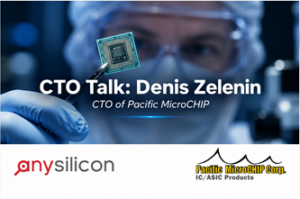
In 2026, Pacific MicroCHIP marks 20 years of ASIC design services and turnkey solutions. We spoke with CTO Denis Zelenin about that journey, the company’s growing range of products—from a 56 GS/s ADC to RF spectrometers—and what customers increasingly expect from custom silicon.
Tell me a bit

Choosing an Arm CPU core starts with the workload, not with the processor name. The right core depends on what the chip must do, the software it must run, the power and area available, whether deterministic real-time behavior is required, and how much performance the system actually needs. Arm offers
Read More
An MPW run is one of the most cost-effective ways to manufacture first silicon when you do not yet need a full dedicated wafer lot. MPW stands for Multi-Project Wafer. Instead of one customer paying for the entire mask set and wafer fabrication process, multiple IC designs share
Read More
TSMC MPW gives chip designers a lower-cost way to manufacture first silicon on TSMC technology without paying for an entire dedicated mask set and wafer run. TSMC operates its multi-project wafer program under the name CyberShuttle®. Several customer designs share the same multi-project mask set, which spreads tooling and wafer
Read More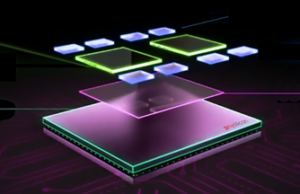
Advanced packaging has become the place where AI system performance is won or lost. High-end performance packaging revenue is forecast to grow to more than $51 billion in 2031, a 27% CAGR during 2025-2031, with package unit volume expanding at a 33% CAGR and wafer demand at 30%.
Read More
body{font-family:Arial,Helvetica,sans-serif;color:#222;line-height:1.7;margin:0;background:#fff}
article{max-width:980px;margin:0 auto;padding:18px 18px 48px}
h1{font-size:38px;line-height:1.2;margin:0 0 20px}
h2{font-size:28px;line-height:1.3;margin:36px 0 14px}
h3{font-size:21px;line-height:1.35;margin:25px 0 10px}
p{margin:0 0 17px}
ul{margin:0 0 20px 22px;padding:0}
li{margin:0 0 7px}
table{width:100%;border-collapse:collapse;margin:18px 0 26px;font-size:15px}
th,td{border:1px solid #d9dde2;padding:11px 12px;text-align:left;vertical-align:top}
th{background:#f3f5f7}
.cta{background:#f6f7f8;border-left:5px solid #d71920;padding:22px;margin:28px 0}
.cta a{display:inline-block;background:#d71920;color:#fff;text-decoration:none;font-weight:700;padding:11px 18px;border-radius:3px}
.note{background:#fff8e8;border:1px solid #eedda7;padding:15px 17px;margin:20px 0}
.small{font-size:13px;color:#666}
@media(max-width:700px){h1{font-size:31px}h2{font-size:24px}table{font-size:14px}}

body { font-family: Arial, Helvetica, sans-serif; color:#222; line-height:1.72; margin:0; }
article { max-width: 980px; margin: 0 auto; padding: 0 18px 40px; }
h1 { font-size:38px; line-height:1.18; margin:0 0 22px; }
h2 { font-size:29px; line-height:1.3; margin:40px 0 15px; }
h3 { font-size:22px; line-height:1.35; margin:28px 0 10px; }
p { margin:0
body {
font-family: Arial, Helvetica, sans-serif;
color:#222;
line-height:1.72;
margin:0;
background:#fff;
}
article {
max-width:980px;
margin:0 auto;
padding:0 18px 42px;
}
h1 {
font-size:38px;
line-height:1.18;
margin:0 0 22px;
Read More
body{
font-family:Arial,Helvetica,sans-serif;
color:#222;
line-height:1.72;
margin:0;
background:#fff;
}
article{
max-width:980px;
margin:0 auto;
padding:0 18px 42px;
}
h1{
font-size:38px;
line-height:1.18;
margin:0 0 22px 0;
}
h2{
font-size:29px;
Read More

body{
font-family:Arial,Helvetica,sans-serif;
color:#222;
line-height:1.72;
margin:0;
background:#fff;
}
article{
max-width:980px;
margin:0 auto;
padding:0 18px 42px;
}
h1{
font-size:38px;
line-height:1.18;
margin:0 0 22px 0;
}
h2{
font-size:29px;
Read More